
Football: Rules, History, Positions, Skills, Tactics & Complete Guide
Football is one of the most popular sports in the world. From packed stadiums to children playing on neighborhood fields, the game has a special ability to bring people together. Millions of fans follow their favorite clubs, national teams, players, leagues, and international competitions every year.
But what makes football so exciting? Is it the goals, the tactics, the skill, the drama, or the incredible stories created during important matches? The answer is probably all of them. Football is more than simply kicking a ball toward a goal. It is a game of teamwork, intelligence, fitness, discipline, creativity, and decision-making.
Like a chess match played at full speed, football requires players to think several moves ahead while reacting instantly to what happens around them. A single pass can change a game, while one moment of individual brilliance can create a memory that fans never forget.
Football: Rules, History, Positions & Complete Guide
Learn football rules, history, positions, skills, tactics, competitions and more in this complete guide to football.
Table of Contents
| Sr# | Headings |
|---|---|
| 1 | What Is Football? |
| 2 | History of Football |
| 3 | Basic Rules of Football |
| 4 | Football Positions Explained |
| 5 | How a Football Match Works |
| 6 | Essential Football Skills |
| 7 | Football Tactics and Formations |
| 8 | Major Football Competitions |
| 9 | Famous Football Players |
| 10 | Football Clubs and Leagues |
| 11 | Football Fitness and Training |
| 12 | Why Football Is So Popular |
| 13 | How to Start Playing Football |
| 14 | The Future of Football |
| 15 | Conclusion |
1. What Is Football?
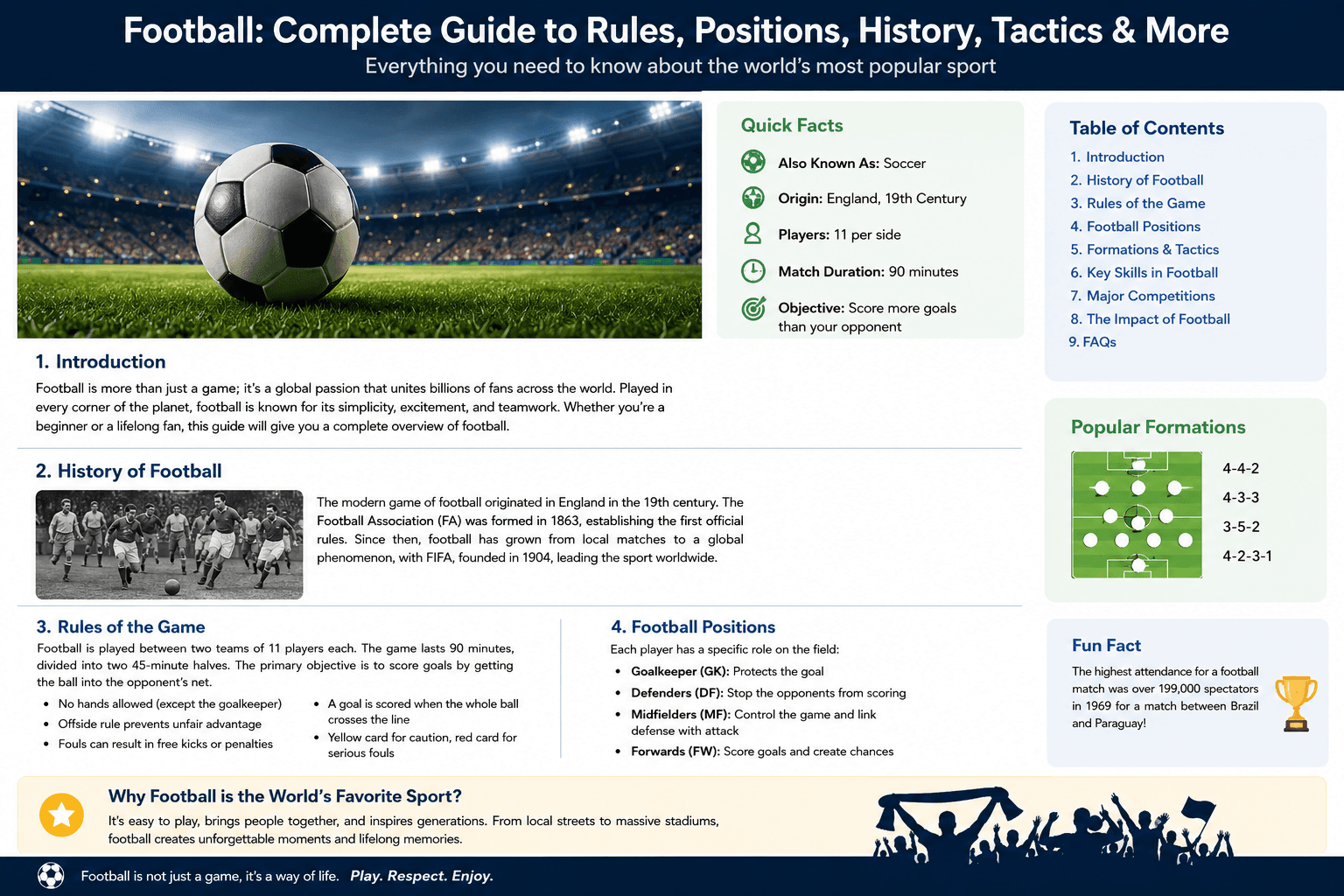
Football is a team sport played between two teams, with the main objective being to score more goals than the opponent. In the traditional form of the game, each team has 11 players on the field, including a goalkeeper.
Players generally use their feet to control, pass, and shoot the ball. They can also use other parts of their body, such as the head, chest, and thighs. The major exception is the goalkeeper, who has special permission to use their hands within their own penalty area.
The simplicity of the basic idea is one reason football has become so popular. You do not need an expensive stadium or complicated equipment to enjoy the game. A ball, some open space, and a group of players can be enough to start.
At professional level, however, football becomes highly sophisticated. Teams use detailed tactical systems, performance analysis, fitness programs, scouting departments, coaching staffs, and advanced technology to gain even the smallest advantage.
What Makes Football Different?
- Teamwork: Players must work together to create chances and defend.
- Strategy: Coaches use formations and tactical plans.
- Skill: Players need excellent control, passing, shooting and movement.
- Fitness: Professional players must maintain high physical standards.
- Entertainment: Goals, rivalries and dramatic moments keep fans engaged.
2. History of Football
The history of football stretches back many centuries. Different cultures played games involving balls and feet long before the modern sport developed its official rules.
The modern form of football began to take shape in the United Kingdom during the 19th century. Different schools and clubs had their own rules, which made matches difficult to organize. The need for standardized regulations eventually led to the development of formal football rules.
The establishment of organized football associations helped create a common framework for the game. Over time, football spread from Britain to Europe, South America, Africa, Asia, North America and other parts of the world.
Football Becomes a Global Sport
As international travel and communication improved, football became increasingly global. Clubs began competing in international tournaments, while national teams started meeting in major competitions.
The creation of the FIFA World Cup became one of the most important moments in football history. The tournament eventually grew into one of the biggest sporting events on the planet.
Today, football is played professionally and recreationally in almost every region of the world. Its history continues to evolve as technology, tactics, training, and business change the modern game.
3. Basic Rules of Football
Understanding the basic rules makes watching football much more enjoyable. While the professional game can seem complicated at first, the fundamental rules are relatively easy to learn.
Number of Players
A standard football team has 11 players on the field. These usually include one goalkeeper and ten outfield players. Teams can also have substitutes available on the bench.
Scoring a Goal
A goal is scored when the entire ball crosses the goal line between the goalposts and underneath the crossbar, provided no attacking infringement has occurred.
Offside Rule
The offside rule prevents attacking players from gaining an unfair advantage by staying too close to the opponent's goal before the ball is played to them. The rule can appear complicated, but its basic purpose is to encourage fair attacking play.
Fouls and Free Kicks
Players can be penalized for actions such as dangerous challenges, holding an opponent, pushing, tripping, or deliberately handling the ball. Depending on the situation, the referee may award a free kick or penalty kick.
Yellow and Red Cards
- Yellow Card: A warning for serious or repeated misconduct.
- Second Yellow: Two yellow cards normally result in a sending-off.
- Red Card: The player is sent off and cannot continue playing.
Penalty Kick
A penalty kick is awarded when a defending player commits a qualifying foul inside their own penalty area. The attacking player takes the kick from the penalty mark against the goalkeeper.
4. Football Positions Explained
Every football position has a different responsibility. A successful team is like a machine: every part has a job, and the machine works best when those parts work together.
Goalkeeper
The goalkeeper protects the team's goal. Their responsibilities include saving shots, controlling crosses, communicating with defenders, and starting attacks from the back.
Defenders
Defenders are responsible for stopping opponents from creating and scoring chances. Common defensive positions include center-back, full-back, and wing-back.
Midfielders
Midfielders connect defense and attack. They often control possession, distribute passes, create chances, and help their team regain the ball.
Forwards
Forwards are primarily responsible for attacking and scoring goals. They need movement, finishing, positioning, speed, strength, and confidence in front of goal.
Common Football Positions
- Goalkeeper
- Center-back
- Full-back
- Wing-back
- Defensive midfielder
- Central midfielder
- Attacking midfielder
- Winger
- Striker
5. How a Football Match Works
A standard professional football match consists of two halves. Each half normally lasts 45 minutes, with additional time added by the referee for certain stoppages.
There is a halftime break between the two halves. During this period, players can recover while coaches discuss tactics and make adjustments.
Extra Time
Some knockout competitions require extra time if the score is level after normal time. Extra time normally consists of two additional periods.
Penalty Shootout
If a knockout match remains level after extra time and the competition rules require a winner, a penalty shootout may be used.
Penalty shootouts can create some of the most dramatic moments in football. A player may spend an entire match preparing mentally for a kick that lasts only a few seconds.
6. Essential Football Skills
Great footballers do not rely on one skill alone. They combine technical ability, physical strength, intelligence, and confidence.
Ball Control
Ball control allows a player to receive and keep possession under pressure. Excellent first touch can give a player extra time to make the next decision.
Passing
Passing is one of the foundations of football. Players must know when to pass short, when to switch play, and when to attempt a more ambitious forward ball.
Dribbling
Dribbling allows players to move with the ball while attempting to beat opponents. Speed changes, body movements, and close control can all help a player escape pressure.
Shooting
Shooting is the skill that turns attacking opportunities into goals. Players can finish with different techniques, including low shots, powerful strikes, chips, volleys, and headers.
Heading
Heading remains important for both attacking and defensive situations. Players use headers to clear danger, win aerial battles, pass, and score goals.
Defending
Defensive skills include tackling, positioning, interception, marking, pressing, and reading the game. Good defending is not simply about making tackles; intelligent positioning can prevent danger before it develops.
7. Football Tactics and Formations
Modern football is heavily influenced by tactics. Coaches spend countless hours studying opponents and deciding how their teams should attack and defend.
4-4-2 Formation
The 4-4-2 is one of the most recognizable football formations. It uses four defenders, four midfielders, and two forwards.
4-3-3 Formation
The 4-3-3 formation provides a strong balance between midfield control and attacking width. It is commonly associated with teams that want to create pressure and use wide attackers.
4-2-3-1 Formation
The 4-2-3-1 provides two deeper midfielders while allowing three attacking players to operate behind a central striker.
Possession Football
Possession-based teams try to control the ball and dictate the rhythm of the match. Short passing, movement, patience, and positioning are important elements.
Counter-Attacking Football
Counter-attacking teams look to transition quickly after winning the ball. Speed and intelligent movement can turn defensive situations into attacking opportunities within seconds.
High Pressing
High pressing involves attempting to win the ball back quickly in advanced areas. It requires coordination, fitness, communication, and discipline.
8. Major Football Competitions
Football has countless competitions, from local tournaments to major international events watched by hundreds of millions of fans.
FIFA World Cup
The FIFA World Cup is the most famous international football tournament. National teams compete for the opportunity to become world champions.
UEFA Champions League
The UEFA Champions League brings together many of Europe's strongest clubs. It is one of the most prestigious club competitions in world football.
UEFA European Championship
The UEFA European Championship is a major international tournament involving European national teams. It has produced many memorable matches and legendary players.
Copa América
Copa América is a major international tournament in South American football and has a long history of producing elite teams and players.
Africa Cup of Nations
The Africa Cup of Nations is one of the most important international competitions in African football, showcasing the continent's talented national teams.
AFC Asian Cup
The AFC Asian Cup is a major tournament for national teams from across Asia and has helped football continue to grow across the region.
9. Famous Football Players
Football history is filled with players who changed the way the game was played and inspired millions of fans.
Pelé
Pelé is widely regarded as one of the greatest footballers ever. His success with Brazil helped make him a global sporting icon.
Diego Maradona
Diego Maradona became famous for his extraordinary dribbling, creativity, and ability to influence important matches.
Lionel Messi
Lionel Messi is celebrated for his dribbling, passing, vision, finishing, and ability to create chances seemingly from nowhere.
Cristiano Ronaldo
Cristiano Ronaldo is known for his goal-scoring ability, athleticism, heading, finishing, discipline, and extraordinary longevity. His career includes major achievements with Manchester United, Real Madrid, Juventus, Portugal, and Al Nassr. The uploaded source similarly highlights his development from Madeira through Sporting CP, Manchester United, Real Madrid, Juventus, Manchester United again, and Al Nassr. :contentReference[oaicite:1]{index=1} :contentReference[oaicite:2]{index=2}
Other Modern Stars
- Kylian Mbappé
- Erling Haaland
- Mohamed Salah
- Kevin De Bruyne
- Harry Kane
- Vinícius Júnior
10. Football Clubs and Leagues
Club football is one of the biggest parts of the sport. Fans often develop lifelong connections with their clubs, following them through successful seasons, difficult periods, and historic rivalries.
Premier League
England's Premier League is one of the world's most watched domestic football competitions. Its international audience, competitive matches, famous clubs, and star players make it a major part of global football culture.
La Liga
Spain's La Liga has traditionally been home to technically gifted players and famous clubs. The competition has also played an important role in the careers of many legendary footballers.
Serie A
Italy's Serie A has a long tradition of tactical football and strong defensive organization. Some of Europe's most historic clubs compete in the league.
Bundesliga
Germany's Bundesliga is known for passionate supporters, strong clubs, attacking football, and excellent youth development.
Ligue 1
France's Ligue 1 has produced and developed many talented players and remains an important European football competition.
11. Football Fitness and Training
Modern football demands exceptional physical preparation. Players may need to sprint, change direction, accelerate, jump, tackle, and recover repeatedly during a match.
Speed Training
Speed is especially valuable for wingers, forwards, and defenders. Sprint training can help players improve acceleration and explosive movement.
Strength Training
Strength helps players compete physically, protect the ball, win challenges, and maintain balance. Professional programs are usually tailored to the player's position and needs.
Endurance
Football requires players to remain active throughout a match. Endurance training helps players maintain their performance over long periods.
Recovery
Recovery is just as important as training. Sleep, nutrition, hydration, stretching, and appropriate rest can help players prepare for their next session or match.
Mental Preparation
Football is also a mental game. Players must handle pressure, mistakes, criticism, competition, and important moments. Confidence and concentration can make a major difference.
12. Why Football Is So Popular
Why does football attract such a massive global audience? One reason is accessibility. People can play the game almost anywhere.
Another reason is emotion. A football match can make supporters celebrate, cry, shout, laugh, and feel nervous within the same 90 minutes.
Football also creates community. Families, friends, neighborhoods, schools, cities, and entire countries can unite behind a team.
Football Brings People Together
A major tournament can create conversations between people who may have very little else in common. Fans can discuss tactics, players, goals, transfers, rivalries, and predictions for hours.
Football Creates Heroes
Every generation produces players who become role models. Young fans often copy the skills, celebrations, hairstyles, and playing styles of their favorite stars.
Football Is Full of Drama
A match can change in seconds. A team can dominate for 80 minutes and still lose. A late goal can turn disappointment into celebration.
That unpredictability is part of football's magic.
13. How to Start Playing Football
You do not need to become a professional to enjoy football. If you want to start, focus on the basics and improve gradually.
Start With Ball Control
Spend time controlling the ball with both feet. Practice receiving passes and keeping the ball close while moving.
Practice Passing
Find a partner or wall and practice short passes. Focus on accuracy before trying difficult techniques.
Improve Your Fitness
Combine running, sprinting, mobility work, and strength exercises appropriate for your age and experience level.
Watch Football
Watching matches can teach you more than just entertainment. Pay attention to player movement, positioning, passing choices, defensive organization, and tactical changes.
Play Regularly
The best way to improve is to play. Join a local team, school group, amateur club, or recreational football community.
14. The Future of Football
The future of football will likely be influenced by technology, analytics, changing tactics, global investment, player development, and new generations of supporters.
Technology in Football
Technology already plays a major role in modern football. Video review systems, goal-line technology, tracking systems, and performance analytics have changed how matches are managed and players are evaluated.
Data and Analytics
Teams increasingly use data to analyze player performance, opposition tendencies, physical workloads, passing patterns, shooting locations, and tactical behavior.
Youth Development
Youth academies remain important because clubs want to develop talented players from an early age. Modern academies increasingly combine technical training with education, physical preparation, and mental development.
Global Growth
Football continues to grow in regions where the sport has historically had a smaller presence. Investment, international competitions, media coverage, and youth programs can help introduce the game to new audiences.
Women’s Football
Women's football has also experienced significant growth in visibility, participation, professional competitions, and fan interest. Its continued development represents an important part of the future of the sport.
15. Football: Skills Every Fan Should Understand
Understanding a few key concepts can make watching football much more enjoyable. Instead of simply watching the ball, try watching what players do when they do not have it.
- Movement: Players constantly create space even without the ball.
- Pressing: Teams may try to win possession immediately after losing it.
- Width: Wide positioning can stretch an opponent's defense.
- Depth: Players use different vertical positions to create passing options.
- Transitions: The moments immediately after gaining or losing possession can be critical.
- Set Pieces: Corners and free kicks can create important scoring opportunities.
Once you begin noticing these details, football becomes almost like reading a story. The ball may be in one area, but the real action could be happening somewhere else on the field.
16. Football Records and Achievements
Football has produced countless records involving goals, appearances, trophies, international matches, and individual awards.
Some players become famous for their goal-scoring records, while others are remembered for their creative ability, defensive performances, leadership, or longevity.
Cristiano Ronaldo, for example, is highlighted in the supplied source for his extensive collection of individual and team achievements, including five Ballon d'Or awards, five UEFA Champions League titles, and his status as Real Madrid's all-time leading scorer. :contentReference[oaicite:3]{index=3}
Records are one of the reasons football history remains fascinating. Every generation produces new players who attempt to challenge the achievements of those who came before them.
17. Football and Global Culture
Football has become part of the culture of many countries. Clubs can represent cities, regions, communities, traditions, and family histories.
A football shirt can be more than clothing. For many supporters, it represents memories, identity, family, and loyalty.
International tournaments can create a similar feeling at national level. When a country's national team plays a major tournament, people from different backgrounds can temporarily come together behind the same colors.
This cultural influence is one reason football remains much more than a sport. It is part of music, fashion, television, social media, business, travel, and everyday conversation.
18. Football Fans and Stadium Atmosphere
Football supporters are a major part of the match-day experience. Chants, flags, banners, songs, scarves, and celebrations can transform a stadium into an unforgettable environment.
A full stadium can create enormous energy. Players often describe the support of fans as an important source of motivation, especially during difficult moments.
Rivalries can make this atmosphere even stronger. Historic rivalries between clubs or national teams often produce matches watched by millions of people around the world.
At its best, football fandom creates a sense of belonging. People may support a club because their parents supported it, because they grew up near the stadium, or simply because they fell in love with the team's history.
19. Football, Analytics and Modern Performance
Modern football has become increasingly connected to data. Coaches and analysts can study thousands of pieces of information to understand how a team performs.
Performance Data
- Distance covered
- Sprint frequency
- Pass completion
- Shots and chances
- Ball recoveries
- Pressing actions
- Defensive actions
Data does not replace football intelligence, but it can provide another layer of information. Coaches can combine statistics with video analysis and their own observations.
For fans, analytics can also make football more interesting by providing additional ways to evaluate players and teams.
20. Why Football Will Continue to Matter
Football has survived changes in technology, media, economics, tactics, and culture because its central idea remains simple: two teams compete, and everyone wants to know what happens next.
The sport can be played by children with almost no equipment, while the professional version can involve enormous stadiums, global television audiences, sophisticated technology, and elite athletes.
That range is what makes football special. A child kicking a ball in a small park and a professional player walking onto a World Cup field are participating in the same basic game.
The rules may evolve, tactics may change, and new stars will appear, but the excitement of football is likely to remain.
Conclusion
Football is more than a game played with a ball and two goals. It is a global sport built around teamwork, skill, strategy, competition, emotion, and community.
From its long history and simple rules to modern tactics, technology, analytics, famous players, clubs, and international tournaments, football continues to influence millions of people around the world.
Whether you are a lifelong supporter, a new fan, or someone learning how to play, there is always something new to discover. That is perhaps the greatest strength of football: the game keeps giving fans another reason to watch, learn, play, and believe.
Frequently Asked Questions (FAQs)
1. What is football?
Football is a team sport in which two teams compete to score more goals than their opponents. A standard team has 11 players on the field, including a goalkeeper.
2. How long is a football match?
A standard football match normally consists of two 45-minute halves, with a halftime interval and additional time added by the referee for certain stoppages.
3. What are the main football positions?
The main positions include goalkeeper, defender, midfielder, winger, and forward. Different formations divide these roles into more specific positions.
4. What is the offside rule in football?
The offside rule is designed to prevent attacking players from gaining an unfair positional advantage near the opponent's goal. Whether an offense has occurred depends on the player's position and involvement in active play when the ball is played by a teammate.
5. Why is football so popular around the world?
Football is accessible, exciting, relatively simple to understand, and deeply connected to community and culture. Major competitions and famous players have also helped make the sport a global phenomenon.
Related Blogs:
- Switzerland vs Colombia — World Cup 2026 Round of 16 Preview
- Harry Kane: Career, Stats, Records & Journey to Football Greatness
- Mohamed Salah Biography: Career, Stats, Achievements & Legacy
Raan, a Harvard alumnus, details analytics and fantasy sports for SportsLNV.