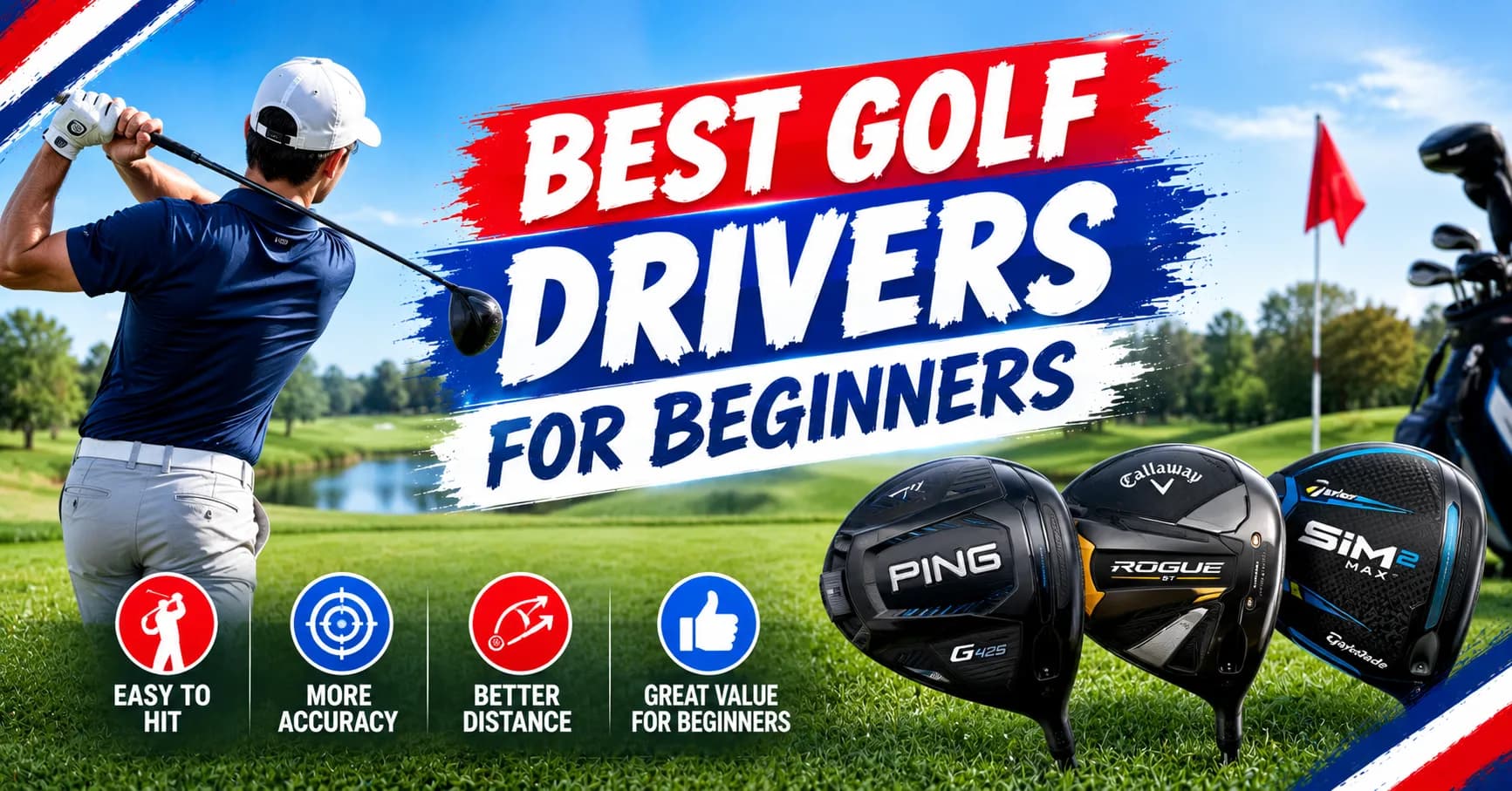
Choosing the right golf driver can make learning the game easier, more enjoyable, and less frustrating. The Best Golf Drivers For Beginners in 2026 focus on forgiveness, easy launch, straighter shots, and confidence off the tee. Instead of choosing a driver simply because it promises maximum distance, beginners should look for a club that helps keep more shots in play, even when contact is not perfect.
Modern drivers use larger clubheads, advanced face designs, adjustable weighting, and lightweight materials to help golfers achieve more consistent results. Options such as the PING G440 K, TaylorMade Qi4D Max, Callaway Quantum Max-D, Wilson DYNAPWR Max+, and Tour Edge Exotics Max are worth considering for their emphasis on stability and forgiveness. The best choice depends on your swing speed, typical ball flight, budget, and whether you tend to slice the ball.
Quick Picks: Best Beginner Golf Drivers in 2026
| Driver | Best for | Main advantage |
|---|---|---|
| PING G440 K | Overall forgiveness | High stability and consistent performance on off-center hits |
| TaylorMade Qi4D Max | Forgiveness and adjustability | Stable head design with adjustable weighting |
| Callaway Quantum Max-D | Golfers who slice | Draw-biased design intended to help reduce a right-curving shot for right-handed golfers |
| Wilson DYNAPWR Max+ | Forgiveness-focused performance | High stability and a confidence-inspiring head shape |
| Tour Edge Exotics Max | Value-oriented buyers | Forgiving design with adjustable weighting |
| Cleveland HiBore XL Lite | Golfers who prefer a lighter club | Lightweight construction designed to help generate clubhead speed |
| Tour Edge Hot Launch Max D | Budget-conscious slicers | Draw-biased features and higher-loft options on selected configurations |
These are recommendations based on the models' design goals and published 2026 equipment coverage, not a guarantee that every golfer will achieve the same results. Where possible, test two or three drivers before purchasing.
1. PING G440 K: Best Overall Driver for Beginners
The PING G440 K is a strong option for beginners who want a forgiving driver that can help maintain more consistent performance across the face. Its high-stability design is intended to limit the loss of performance on off-center strikes, a common problem for golfers who are still developing their swing.
Why beginners should consider it
- High forgiveness: The design prioritizes stability on imperfect contact.
- Confidence at address: The head shape can help golfers feel comfortable before swinging.
- Adjustability: The weighting system and adjustable hosel provide options for tuning ball flight.
- Consistent performance: Its forgiveness-focused design makes it worth testing for golfers who frequently miss the center of the face.
Potential drawbacks
The PING G440 K is a premium-priced driver, so it may not be the best financial choice for someone who is still deciding whether to commit to golf. Its adjustability can also be unnecessary for a beginner who has not yet developed a consistent swing.
Best for: Beginners who want a premium, forgiveness-focused driver and expect to keep playing as their skills improve.
2. TaylorMade Qi4D Max: Best for Forgiveness and Adjustability
The TaylorMade Qi4D Max is designed for golfers who value stability, easy launch, and the ability to adjust performance characteristics. Beginners often make inconsistent contact at different points on the clubface, so a forgiving driver can help reduce the effect of some mishits.
Key benefits
- Stable clubhead: The Max design emphasizes forgiveness and consistency.
- Adjustable weighting: Depending on the configuration, golfers can tune launch and spin characteristics.
- Modern face technology: The design aims to maintain useful ball speed across more of the hitting area.
- Room to improve: Its adjustment options may remain useful as a player's swing develops.
Potential drawbacks
Premium technology comes at a higher price than many entry-level options. Beginners should also avoid changing settings repeatedly without understanding how those adjustments affect their ball flight.
Best for: Golfers looking for a premium driver with forgiveness and adjustment options as their game develops.
3. Callaway Quantum Max-D: Best Driver for Beginners Who Slice
A slice is a shot that curves significantly to the right for a right-handed golfer or to the left for a left-handed golfer. It is a common challenge for beginners and can cause players to lose distance, miss fairways, and spend extra strokes recovering from difficult positions.
The Callaway Quantum Max-D is designed with draw bias to help golfers who tend to leave the clubface open relative to their swing path. Its weighting and head design aim to encourage a more favorable ball flight for players who regularly struggle with a slice.
Why it may help
- Draw-biased design: Helps support a less right-curving flight for many right-handed golfers.
- Forgiveness: The head design prioritizes stability on imperfect strikes.
- Launch assistance: Suitable configurations can help golfers get the ball airborne.
- Adjustability: Available settings may help fine-tune the setup.
What to consider before buying
Draw bias is not a universal solution for every swing problem. Golfers who naturally hook the ball or pull shots to the left may prefer a more neutral driver. A lesson and a basic fitting can help identify whether the slice comes from clubface alignment, swing path, grip, or a combination of factors.
Best for: Beginners whose main problem is a persistent slice and who want to test a draw-biased driver.
4. Wilson DYNAPWR Max+: Best for Forgiveness at a Competitive Price
The Wilson DYNAPWR Max+ is a forgiveness-focused driver designed to compete with more expensive models. Its high-stability head and weight distribution aim to help maintain performance when the ball is struck away from the center of the face.
Advantages
- Forgiving design: Helps reduce the impact of some off-center strikes.
- Confidence-inspiring shape: A larger-looking head can make setup feel more comfortable for new golfers.
- Distance potential: The face and head construction are designed to support ball speed.
- Alternative to premium brands: Worth comparing if you want forgiveness without automatically choosing the most expensive driver.
Potential drawbacks
Its feel, sound, shaft options, and overall performance may not suit every player. Beginners should compare the club with alternatives instead of assuming a high-forgiveness rating guarantees better results for their individual swing.
Best for: Beginners who want a modern, forgiving driver and are comparing premium and mid-priced choices.
5. Tour Edge Exotics Max: Best Value-Oriented Forgiving Driver
The Tour Edge Exotics Max is worth considering for golfers who want forgiveness and useful adjustment options without immediately paying top-tier flagship prices. Its design emphasizes stability, face performance, and weight placement to help deliver more consistent results.
Why it deserves consideration
- Forgiveness-focused construction: Designed to help on shots that miss the center of the face.
- Adjustable weighting: Can provide additional options for tuning the ball flight.
- Value: A useful model to compare with premium drivers when managing a budget.
- Developing-player appeal: Its features can be helpful while a beginner works toward more repeatable contact.
Potential drawbacks
Feel, sound, launch, and distance can differ from those of more expensive competitors. Availability and shaft configurations may also vary by retailer, so check the exact model and specifications before buying.
Best for: Beginners who want a forgiving driver and are comparing value against premium alternatives.
6. Cleveland HiBore XL Lite: Best Lightweight Option
A heavy or poorly matched driver can make it harder for some beginners to develop a comfortable swing. The Cleveland HiBore XL Lite is designed for golfers who prefer a lighter setup that may help them generate clubhead speed without feeling as though they have to force the swing.
Benefits for new golfers
- Lightweight construction: Can suit golfers who find heavier clubs difficult to swing comfortably.
- Easy-to-use design: A beginner-friendly option to test for launch and overall comfort.
- Potential speed assistance: A suitable lighter shaft and head combination may help some golfers swing more freely.
- Useful for fitting comparisons: Can be compared against standard-weight drivers to see which produces better contact.
Potential drawbacks
Lighter does not automatically mean longer or straighter. Some golfers lose control when a club is too light, while others benefit from the easier feel. The best option depends on your swing tempo, strength, and ability to make consistent contact.
Best for: Beginners who have a slower swing speed or prefer a lighter-feeling club.
7. Tour Edge Hot Launch Max D: Best Budget Option for Slicers
Beginners do not necessarily need to spend a large amount on a new driver. The Tour Edge Hot Launch Max D is a budget-oriented option worth investigating, especially for golfers who struggle with a slice and want a club with draw-biased features.
Why it can be a sensible choice
- Budget-friendly positioning: Offers an alternative to premium-priced flagship drivers.
- Draw-oriented design: Intended to help players who commonly lose shots to the right.
- Higher-loft configurations: Selected versions offer loft options that may help some beginners launch the ball more easily.
- Practical first-driver choice: Can be appropriate for learning the basics before investing in more expensive equipment.
Potential drawbacks
Budget models may provide fewer adjustment options or different materials and feel compared with premium drivers. Check the exact model year, available lofts, shaft flex, hand orientation, and retailer's return policy before purchasing.
Best for: New golfers who want an affordable driver with slice-helping design features.
How to Choose the Best Golf Driver for Beginners
The best beginner driver is the one that fits your swing and helps you make more repeatable contact. A popular model may perform exceptionally well for one golfer and less effectively for another. Consider the following factors before making a decision.
1. Forgiveness and Stability
Forgiveness is one of the most important features for a beginner. When the ball is struck away from the center of the clubface, a forgiving driver is designed to reduce the loss of ball speed or limit unwanted changes in ball direction.
Look for a model that performs consistently across the face rather than choosing solely on the basis of its maximum-distance claims. A more playable drive can be more valuable than a longer shot that frequently lands out of bounds.
2. Driver Loft
Loft is the angle of the clubface that helps launch the ball into the air. Many beginners benefit from testing a driver with approximately 10.5 to 12 degrees of loft, and some may perform better with even more loft depending on their swing speed and delivery.
A lower-lofted driver is not automatically longer. If your shots launch too low, a higher-lofted model may help increase carry distance and make the ball easier to control. Test different settings or loft options to find a launch that works for your swing.
3. Shaft Flex
The shaft influences how the club feels during the swing and how it delivers the clubhead to the ball. Common flex categories include extra stiff, stiff, regular, senior, and ladies, although naming and availability vary by manufacturer.
Beginners should not select shaft flex based on age, height, or strength alone. Swing speed, tempo, transition, and ball flight all matter. A qualified club fitter can help match the shaft to your swing.
4. Head Size and Shape
Many modern drivers use a head close to the maximum permitted 460cc volume. Larger, confidence-inspiring head shapes can help beginners feel comfortable at address, while the distribution of weight influences stability and launch.
Try setting the club behind a ball and checking whether the shape helps you aim naturally. Visual confidence is not a substitute for performance testing, but it can make the club easier to use consistently.
5. Draw Bias and Slice Correction
If your drives repeatedly curve to the right as a right-handed player, a draw-biased driver may be worth testing. Such designs use weighting or other features intended to influence the club's delivery and resulting ball flight.
However, a draw-biased driver does not replace swing instruction. If you hook the ball or already produce a draw, a neutral model may offer a better starting point.
6. Budget and Long-Term Value
New drivers range from relatively affordable models to premium products with advanced materials and extensive adjustment options. A higher price does not guarantee lower scores, particularly when a beginner's swing is still changing.
Consider last-generation drivers, certified pre-owned clubs, and reputable used equipment retailers. Check the clubface, crown, shaft, grip, and hosel for damage, and make sure the club is suitable for your hand orientation and swing.
What Is the Best Driver Loft for a Beginner?
For many beginners, a driver with 10.5 or 12 degrees of loft is a sensible starting point for testing. A golfer with a slower swing speed may benefit from a higher-lofted setup, while a player who launches the ball too high may need a different configuration.
| Loft range | Who might consider it? | What to watch for |
|---|---|---|
| 9°–10° | Some faster swingers or players who already launch the ball high | May produce a flight that is too low for some beginners. |
| 10.5° | A common starting point for a wide range of golfers | Still depends on swing speed, impact, and delivered loft. |
| 12° and above | Some slower swingers and golfers who struggle to launch the ball | Check whether the launch and spin provide useful carry distance. |
These ranges are general guidance, not strict rules. Adjustable hosels may change the effective loft and face presentation, so test the actual setting rather than relying only on the number printed on the club.
Should Beginners Buy a New or Used Golf Driver?
A new driver offers current technology, a fresh grip, and usually a clearer warranty or return policy. A used driver can offer excellent value, especially if it comes from a reputable retailer and has been inspected for damage.
| Factor | New driver | Used driver |
|---|---|---|
| Cost | Usually higher | Often lower |
| Condition | Typically new and unused | Depends on previous use and inspection |
| Technology | Access to the latest model features | Older technology may still perform well |
| Warranty | Depends on the manufacturer's and retailer's terms | May be limited or unavailable |
| Beginner suitability | Can be excellent if properly fitted | Can be excellent if the specifications and condition are suitable |
For a beginner, a properly fitted used driver may be a better investment than an expensive new model with the wrong shaft or loft. Prioritize condition and fit over age or brand prestige.
Common Mistakes Beginners Make When Buying a Driver
- Choosing distance over forgiveness: A long drive is less useful if it regularly misses the fairway.
- Buying the lowest loft available: Lower loft does not automatically create more distance.
- Ignoring shaft flex: A poorly matched shaft can make timing and contact more difficult.
- Assuming draw bias fixes every slice: Equipment can influence ball flight, but swing mechanics remain important.
- Buying without testing: Compare launch, carry distance, dispersion, and comfort whenever possible.
- Paying for features you do not need: Beginners may not benefit from every advanced adjustment.
- Ignoring hand orientation: Confirm whether the club is right-handed or left-handed before buying.
- Overlooking used equipment: A well-maintained previous-generation driver can be a smart value choice.
How to Test a Driver Before Buying
Testing a driver is one of the best ways to identify which model suits your swing. If a golf shop or fitting center offers a launch monitor, use the same golf balls and similar conditions when comparing clubs.
- Warm up with a few comfortable swings before collecting results.
- Try drivers with different lofts and shaft flexes when available.
- Hit several shots with each model instead of judging a single swing.
- Compare carry distance, ball speed, launch angle, spin, and shot dispersion.
- Look at how many shots finish in a playable area, not only your best result.
- Choose the model that combines comfortable feel with repeatable performance.
Beginners do not need to understand every launch-monitor measurement. Focus first on making solid contact, getting the ball airborne, and keeping more drives in play. As your swing improves, you can revisit fitting and adjustment choices.
Frequently Asked Questions About Beginner Golf Drivers
What is the best golf driver for beginners in 2026?
The PING G440 K is a strong premium option for golfers prioritizing forgiveness. The TaylorMade Qi4D Max, Callaway Quantum Max-D, Wilson DYNAPWR Max+, and Tour Edge models are also worth testing, depending on your swing, budget, and tendency to slice.
How much should a beginner spend on a golf driver?
There is no fixed amount a beginner needs to spend. Affordable new models and good-condition used drivers can be suitable choices. Set a budget first, then prioritize the right loft, shaft, forgiveness, and condition over the highest price.
Is a 10.5-degree or 12-degree driver better for beginners?
Both can work. A 10.5-degree driver is a common starting point, while 12 degrees or more may help some golfers who struggle to launch the ball. Testing different lofts is more reliable than choosing by a general rule.
Should a beginner use a regular-flex shaft?
Regular flex can suit many golfers, but it is not right for everyone. Shaft selection should consider swing speed, tempo, transition, and ball flight. A fitting session can help determine which flex works best.
What is the most forgiving golf driver in 2026?
The PING G440 K is frequently highlighted in 2026 beginner-driver reviews for forgiveness. Other high-stability options include the TaylorMade Qi4D Max and Wilson DYNAPWR Max+. Individual results can vary, so test the models against your own swing.
Which golf driver is best for beginners who slice?
The Callaway Quantum Max-D and other draw-biased models are worth testing if you consistently slice. A draw-biased driver may influence ball flight, but lessons and improved contact can be equally important.
Are expensive golf drivers worth it for beginners?
Not always. Premium drivers may offer advanced materials, adjustment options, and strong forgiveness, but an affordable or used driver can also perform well. Proper fit and consistent contact matter more than price alone.
Can a beginner use a professional golfer's driver?
A beginner can use a professional-style driver, but it may not be the easiest choice. Some models are designed for lower launch, lower spin, or faster swings. Beginners generally benefit from testing forgiving models designed to help maintain playable results.
How often should beginners replace their golf driver?
Beginners do not need to replace a driver every year. Consider replacing it if the club is damaged, no longer fits your swing, or a properly tested alternative produces meaningfully better results.
Is a used golf driver good for beginners?
Yes. A used driver can provide excellent value if it is in good condition and has a suitable loft, shaft, and grip. Buy from a reputable source and check for cracks, face damage, shaft problems, and signs of improper repairs.
Final Verdict: Which Beginner Golf Driver Should You Choose?
The best golf driver for beginners in 2026 is the one that helps you launch the ball comfortably and keep more shots in play. The PING G440 K is worth considering for premium forgiveness, the TaylorMade Qi4D Max offers adjustability, and the Callaway Quantum Max-D is a sensible model to test if slicing is your main challenge. Budget-conscious players should compare the Tour Edge Exotics Max and Hot Launch Max D, while golfers who prefer a lighter club can try the Cleveland HiBore XL Lite.
Before buying, compare at least two or three models, test different lofts when possible, and choose a shaft that matches your swing. You do not need the most expensive driver to improve your game. A comfortable, forgiving club and consistent practice can make a much bigger difference to your progress on the course.
More Sports Stories to Explore
Golfers who enjoy following other major sports can also explore the career of Rafael Nadal Career, including his achievements and legacy on clay courts. Tennis fans can read about the Carlos Alcaraz vs Jannik Sinner Hype and explore the US Open 2026 Draw & Predictions for tournament storylines and match expectations. You can also discover more about the playing style and career of Nick Kyrgios Career.