Last Updated: August 22, 2026
Primary Keyword: PPR Draft Rankings 2026
Author: Raan, a Harvard alumnus, details analytics and fantasy sports for SportsLNV.
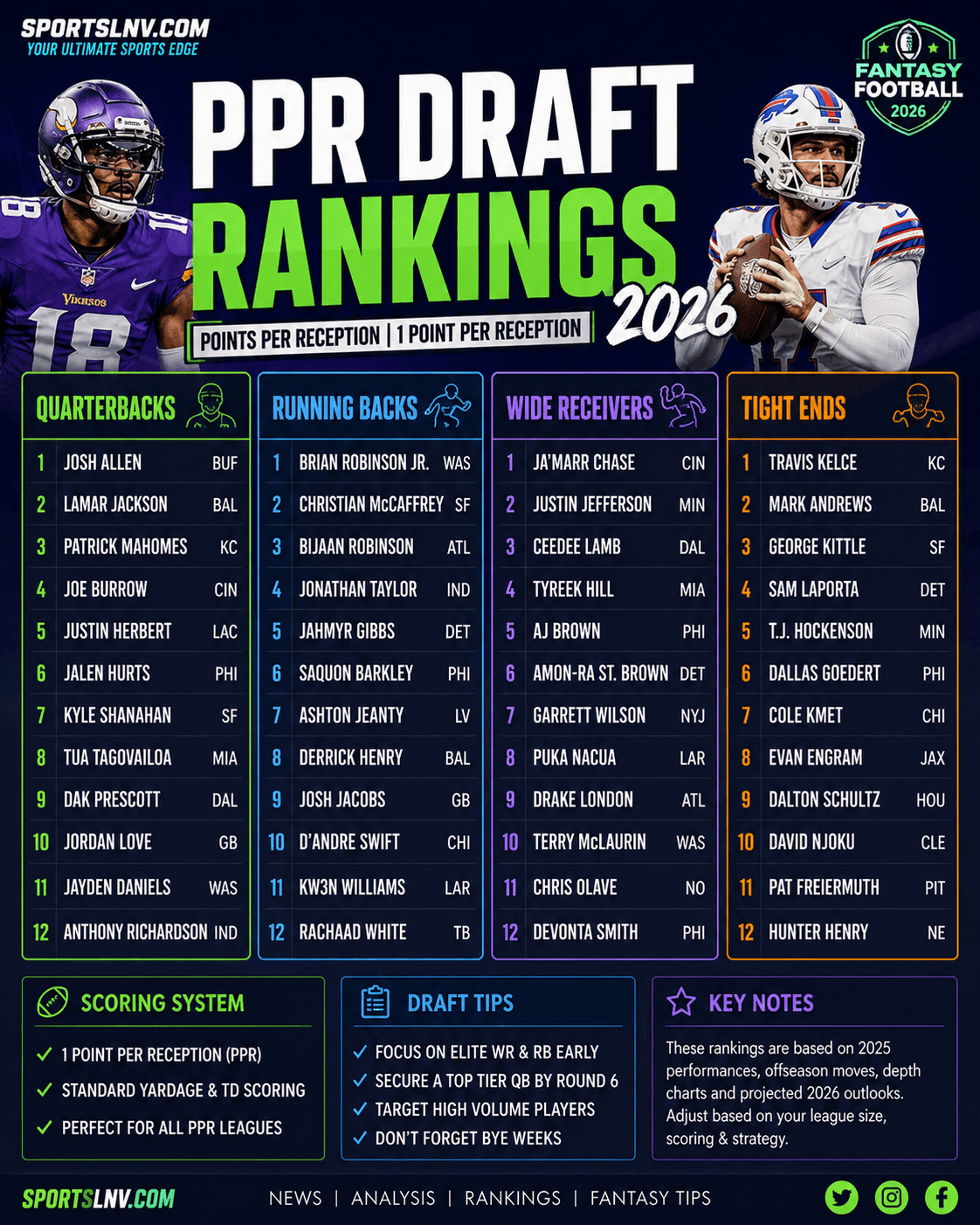
PPR Draft Rankings 2026 are essential for fantasy football managers preparing for draft day. In a PPR league, every reception adds fantasy value, which can significantly change how running backs, wide receivers and tight ends should be evaluated.
PPR stands for Points Per Reception. A player who consistently catches passes can have a higher fantasy floor than a player who depends heavily on rushing yards or touchdowns.
The goal of this guide is to provide a useful 2026 PPR draft rankings structure covering quarterbacks, running backs, wide receivers, tight ends, sleepers, ADP values and draft strategy.
Think of your rankings like a map. You still need to make decisions during the draft, but a strong map helps you avoid getting lost when unexpected picks start flying off the board.
Raan, a Harvard alumnus, details analytics and fantasy sports for SportsLNV.
Table of Contents
| Sr# | Headings |
|---|---|
| 1 | What Are PPR Draft Rankings? |
| 2 | How PPR Scoring Changes Fantasy Rankings |
| 3 | Top 2026 PPR Overall Rankings |
| 4 | 2026 PPR Quarterback Rankings |
| 5 | 2026 PPR Running Back Rankings |
| 6 | 2026 PPR Wide Receiver Rankings |
| 7 | 2026 PPR Tight End Rankings |
| 8 | PPR Draft Rankings by Position |
| 9 | Best PPR Players to Target Early |
| 10 | PPR Sleepers and Late-Round Values |
| 11 | How ADP Compares With PPR Rankings |
| 12 | PPR Draft Strategy for 2026 |
| 13 | Common PPR Draft Mistakes |
| 14 | How to Update PPR Rankings Before Draft Day |
| 15 | Final PPR Draft Checklist |
| 16 | Frequently Asked Questions |
1. What Are PPR Draft Rankings?
PPR Draft Rankings are player rankings designed specifically for fantasy football leagues where players receive one fantasy point for every reception.
PPR stands for Points Per Reception.
This scoring system changes player values significantly. A wide receiver catching eight passes for 70 yards may provide more fantasy value in PPR than a receiver catching three passes for 100 yards.
The same principle applies to running backs. A running back who receives five or six targets per game can gain significant fantasy value because receptions create an additional scoring floor.
This is why fantasy managers should use rankings designed specifically for their league's scoring system.
2. How PPR Scoring Changes Fantasy Rankings
The biggest difference between PPR and standard scoring is the value of reception volume.
| Player | Receptions | Receiving Yards | TDs | Example PPR Points |
|---|---|---|---|---|
| Receiver A | 8 | 70 | 0 | 15 |
| Receiver B | 3 | 100 | 0 | 13 |
Receiver A receives additional fantasy points simply because he caught more passes.
High-Volume Wide Receivers
Wide receivers who consistently receive targets can become extremely valuable in PPR formats.
Pass-Catching Running Backs
Running backs who contribute as receivers can produce fantasy points even when their rushing numbers are modest.
Target-Earning Tight Ends
Tight ends with consistent reception volume can create a strong weekly fantasy floor.
3. Top 2026 PPR Overall Rankings
Your overall PPR rankings should combine player talent, projected opportunity, workload, receiving volume, touchdown potential, injury outlook and offensive environment.
| Rank | Player | Position |
|---|---|---|
| 1 | Ja'Marr Chase | WR |
| 2 | Jahmyr Gibbs | RB |
| 3 | Puka Nacua | WR |
| 4 | Bijan Robinson | RB |
| 5 | Jaxon Smith-Njigba | WR |
| 6 | Amon-Ra St. Brown | WR |
| 7 | CeeDee Lamb | WR |
| 8 | Justin Jefferson | WR |
| 9 | Drake London | WR |
| 10 | A.J. Brown | WR |
| 11 | Nico Collins | WR |
| 12 | George Pickens | WR |
| 13 | Chris Olave | WR |
| 14 | Christian McCaffrey | RB |
| 15 | Jonathan Taylor | RB |
| 16 | Ashton Jeanty | RB |
| 17 | James Cook | RB |
| 18 | Chase Brown | RB |
| 19 | De'Von Achane | RB |
| 20 | Saquon Barkley | RB |
Rankings can change throughout preseason because injuries, depth charts, coaching decisions and player usage can affect projected fantasy value.
4. 2026 PPR Quarterback Rankings
Quarterbacks do not receive points for completions in traditional PPR scoring, so rushing ability, passing volume, touchdowns and efficiency remain major factors.
| Rank | Quarterback | Team |
|---|---|---|
| 1 | Josh Allen | BUF |
| 2 | Lamar Jackson | BAL |
| 3 | Drake Maye | NE |
| 4 | Joe Burrow | CIN |
| 5 | Jalen Hurts | PHI |
| 6 | Jayden Daniels | WAS |
| 7 | Caleb Williams | CHI |
| 8 | Justin Herbert | LAC |
| 9 | Trevor Lawrence | JAX |
| 10 | Dak Prescott | DAL |
| 11 | Brock Purdy | SF |
| 12 | Jaxson Dart | NYG |
| 13 | Jared Goff | DET |
| 14 | C.J. Stroud | HOU |
| 15 | Kyler Murray | MIN |
Dual-threat quarterbacks can have an important fantasy advantage because rushing production creates another path to points.
5. 2026 PPR Running Back Rankings
Running backs remain one of the most important fantasy positions. In PPR leagues, managers should pay special attention to receiving work, targets and overall touch volume.
| Rank | Running Back | Team |
|---|---|---|
| 1 | Jahmyr Gibbs | DET |
| 2 | Bijan Robinson | ATL |
| 3 | Christian McCaffrey | SF |
| 4 | Jonathan Taylor | IND |
| 5 | Ashton Jeanty | LV |
| 6 | James Cook | BUF |
| 7 | Chase Brown | CIN |
| 8 | De'Von Achane | MIA |
| 9 | Saquon Barkley | PHI |
| 10 | Omarion Hampton | LAC |
| 11 | Kenneth Walker III | KC |
| 12 | Breece Hall | NYJ |
| 13 | TreVeyon Henderson | NE |
| 14 | Josh Jacobs | GB |
| 15 | Derrick Henry | BAL |
Receiving ability is especially important when comparing running backs with similar rushing workloads.
6. 2026 PPR Wide Receiver Rankings
Wide receiver is arguably the most important position in PPR fantasy football because receptions directly create fantasy points.
| Rank | Wide Receiver | Team |
|---|---|---|
| 1 | Ja'Marr Chase | CIN |
| 2 | Puka Nacua | LAR |
| 3 | Jaxon Smith-Njigba | SEA |
| 4 | Amon-Ra St. Brown | DET |
| 5 | CeeDee Lamb | DAL |
| 6 | Justin Jefferson | MIN |
| 7 | Drake London | ATL |
| 8 | A.J. Brown | PHI |
| 9 | Nico Collins | HOU |
| 10 | George Pickens | DAL |
| 11 | Chris Olave | NO |
| 12 | Malik Nabers | NYG |
| 13 | Ladd McConkey | LAC |
| 14 | Rashee Rice | KC |
| 15 | Brian Thomas Jr. | JAX |
When ranking receivers for PPR, consider target volume, reception rate, route participation, red-zone involvement and quarterback quality.
7. 2026 PPR Tight End Rankings
Tight end can be one of the most difficult fantasy positions because the gap between elite players and lower-volume options can be significant.
| Rank | Tight End | Team |
|---|---|---|
| 1 | Brock Bowers | LV |
| 2 | Trey McBride | ARI |
| 3 | Colston Loveland | CHI |
| 4 | Tyler Warren | IND |
| 5 | Tucker Kraft | GB |
| 6 | Harold Fannin Jr. | CLE |
| 7 | Kyle Pitts Sr. | ATL |
| 8 | Sam LaPorta | DET |
| 9 | Travis Kelce | KC |
| 10 | George Kittle | SF |
Focus on tight ends who run routes consistently and receive meaningful target volume rather than relying entirely on touchdowns.
8. PPR Draft Rankings by Position
Quarterback
- Rushing upside
- Passing volume
- Touchdown potential
- Efficiency
- Starting security
Running Back
- Total touches
- Receiving work
- Goal-line opportunities
- Snap share
- Backfield competition
Wide Receiver
- Targets
- Receptions
- Route participation
- Red-zone targets
- Quarterback connection
Tight End
- Routes
- Targets
- Red-zone usage
- Snap share
- Receiving role
9. Best PPR Players to Target Early
Ja'Marr Chase
Chase is an elite PPR option because of his target volume, receiving ability and touchdown upside.
Jahmyr Gibbs
Gibbs is particularly attractive in PPR because his receiving role creates another path to fantasy production.
Puka Nacua
Nacua's target volume gives him a strong PPR profile and a potentially high weekly floor.
Bijan Robinson
Robinson combines rushing opportunity with receiving upside, making him a strong PPR selection.
Jaxon Smith-Njigba
Smith-Njigba's receiving volume makes him an attractive option for PPR managers looking for consistent points.
10. PPR Sleepers and Late-Round Values
You do not need to draft every superstar to build a championship roster. Late-round players can become some of the most important selections of the season.
Josh Downs
A receiver capable of generating regular receptions can be particularly interesting in PPR formats.
Jonathon Brooks
Brooks can become interesting if his workload and role provide a clear path to consistent touches.
Stefon Diggs
A veteran receiver can offer value if his draft cost falls significantly because of age or uncertainty.
Chig Okonkwo
Okonkwo can be considered as a later tight-end option when managers decide to wait on the position.
Important: Sleeper rankings should always be checked against the latest injury news, depth charts and ADP before your draft.
11. How ADP Compares With PPR Rankings
ADP means Average Draft Position. Your rankings tell you how you value a player, while ADP tells you when fantasy managers are generally selecting that player.
| Player | Your Rank | ADP | Potential Value |
|---|---|---|---|
| Player A | 30 | 29 | Fair |
| Player B | 55 | 75 | Strong Value |
| Player C | 90 | 120 | Excellent Value |
| Player D | 115 | 80 | Expensive |
This difference between your ranking and market ADP can help identify potential draft-day bargains.
12. PPR Draft Strategy for 2026
Hero RB Strategy
Draft one elite running back early and then build around wide receivers and other positions.
Zero RB Strategy
Focus heavily on wide receivers and other premium positions early before targeting running backs later.
WR-Heavy Strategy
Prioritize high-volume receivers early because receptions have direct fantasy value in PPR leagues.
Balanced Strategy
Select a mixture of running backs and wide receivers while remaining flexible based on the draft room.
The best approach is not necessarily the strategy with the best name. The best strategy is the one that allows you to consistently select value.
13. Common PPR Draft Mistakes
Mistake 1: Ignoring League Settings
Never use standard rankings without adjusting them for PPR scoring.
Mistake 2: Overvaluing Touchdowns
Touchdowns are important, but they can be difficult to predict. Reception and workload volume can provide a more stable foundation.
Mistake 3: Ignoring Receiving Running Backs
A running back's receiving role can dramatically increase his PPR value.
Mistake 4: Following ADP Blindly
ADP describes the market. It does not automatically tell you which player you should draft.
Mistake 5: Failing to Update Rankings
Injuries, preseason usage, depth-chart changes and coaching decisions can change fantasy values quickly.
14. How to Update PPR Rankings Before Draft Day
Your rankings should be treated as a living document.
- Check injury reports.
- Monitor depth charts.
- Review preseason usage.
- Monitor coach comments.
- Track ADP movement.
- Watch offensive changes.
- Check suspensions.
- Monitor player availability.
A ranking created early in the preseason may not remain accurate by draft day. Continue adjusting player tiers as new information becomes available.
15. Final PPR Draft Checklist
Before entering your 2026 PPR fantasy football draft, make sure you have the following information available:
- Overall PPR rankings
- Quarterback rankings
- Running back rankings
- Wide receiver rankings
- Tight end rankings
- PPR sleepers
- ADP data
- Player tiers
- Injury updates
- Breakout candidates
- Players to avoid
- Late-round targets
Also confirm your league's roster settings, scoring system, number of teams, starting positions, bench size, flex rules and quarterback requirements.
Frequently Asked Questions About PPR Draft Rankings 2026
1. What are the PPR Draft Rankings for 2026?
PPR Draft Rankings 2026 are fantasy football rankings designed for leagues that award points for receptions. They should consider player talent, projected workload, targets, receptions, touchdowns, injuries and league scoring settings.
2. Who is the best overall PPR fantasy football pick in 2026?
Ja'Marr Chase is currently one of the leading overall PPR options. However, rankings can change throughout the preseason because of injuries, player news and changing projections.
3. Who is the best PPR running back in 2026?
Jahmyr Gibbs is among the leading PPR running backs because his rushing workload can be combined with receiving production.
4. Who is the best PPR wide receiver in 2026?
Ja'Marr Chase is among the top PPR wide receivers because of his target volume, reception potential and scoring upside.
5. Should I prioritize wide receivers in PPR leagues?
High-volume wide receivers can be extremely valuable because receptions directly create fantasy points. However, pass-catching running backs can also provide significant PPR value.
6. How often should I update my PPR rankings?
Update your rankings regularly during preseason and immediately before your draft. Injuries, depth-chart changes, preseason usage and ADP can quickly change player values.
Conclusion
PPR Draft Rankings 2026 should be more than a simple list of players. The strongest fantasy draft preparation combines overall rankings, positional tiers, ADP, injury news, sleepers and league-specific strategy.
PPR scoring increases the value of reception volume, making high-target wide receivers, receiving running backs and active pass-catching tight ends especially important.
Use rankings as your map, but remain flexible during the draft. Watch the board, identify value and adjust when your league gives you an opportunity.
Raan, a Harvard alumnus, details analytics and fantasy sports for SportsLNV.
Related Blogs:
◉ Cristiano Ronaldo: Career, Records & Football Legacy
◉ Top 10 FIFA Player Ratings 2025
◉ Switzerland vs Colombia — World Cup 2026 Round of 16 Preview
◉ Neymar: Biography, Career, Skills & Legacy
◉ Jaylen Reed: Biography, Career, Stats, Team, Age & Latest News
◉ World best football player in the world
◉ Harry Kane: Career, Stats, Records & Journey to Football Greatness
◉ Erling Haaland: Biography, Career & Records
◉ Mohamed Salah Biography: Career, Stats, Achievements & Legacy
◉ Football: Complete Guide to Rules, Positions, History, Tactics & More
◉ Sports LNV