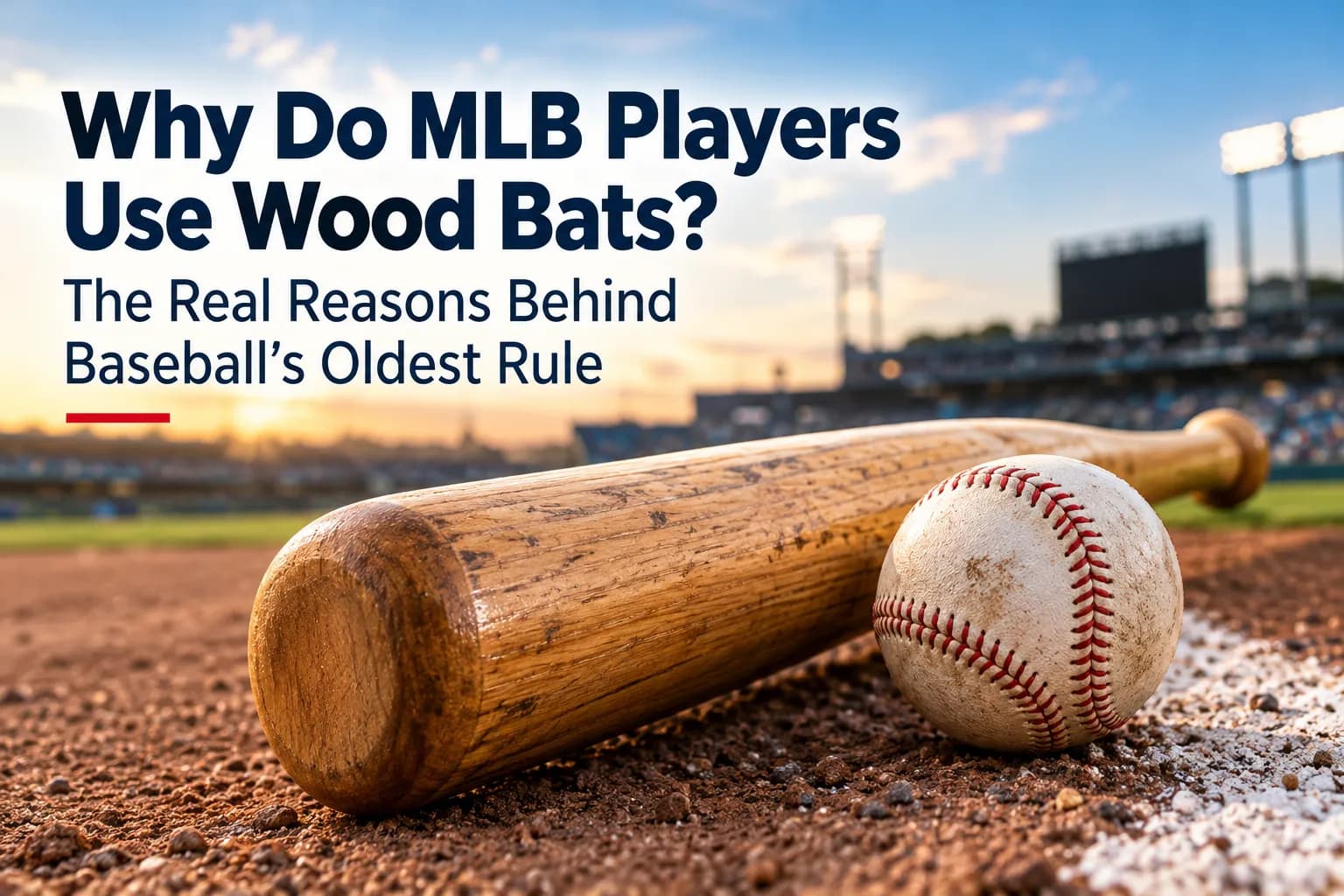
MLB players use wood bats because the rulebook says so. Rule 3.02 requires a bat made of one piece of solid wood, and the league has kept that rule for three reasons: safety, skill, and history. A metal bat could send the ball back at the pitcher faster, hide a hitter's mistakes, and turn more than a century of home run records into apples and oranges.
If you grew up on aluminum, the first time you hear a big leaguer's maple bat crack on a 98 mph fastball, it sounds like a different sport. In a way, it is. Every kid in America swings metal from tee ball through high school, then the ones who make it to pro ball have to relearn hitting with a piece of wood that gives them almost nothing for free.
So why hasn't Major League Baseball switched to aluminum or composite, when nearly every other level of the game did decades ago? Here's the real story, from the rulebook to the science to the torpedo bats that took over spring training in 2025.
What the MLB Rule Actually Says
The answer starts with Rule 3.02 of the Official Baseball Rules. It's short, and it's strict.
| Rule 3.02 Requirement | What It Means |
|---|---|
| One piece of solid wood | No aluminum, no composite, no hollow barrels |
| Smooth, round stick | No flat spots, grooves, or unusual shapes |
| 2.61 inches or less in diameter | Thinner than the 2-5/8-inch barrels allowed in youth and high school baseball |
| 42 inches or less in length | Few players go anywhere near the limit; many swing 33- to 35-inch bats |
| Cupped end allowed | The hollowed-out end can be up to 1-1/4 inches deep and 1 to 2 inches wide |
| Pine tar on the handle only | No more than 18 inches up from the knob |
| Laminated or experimental bats | Barred in professional games until MLB approves the design and manufacturing process |
| Colored bats | Allowed only with MLB approval |
That 18-inch pine tar limit is the rule behind one of baseball's most famous meltdowns. In 1983, George Brett's go-ahead home run at Yankee Stadium was taken away because his pine tar ran too far up the bat. He came storming out of the dugout, and the American League later reversed the call. The point is that MLB cares about every inch of the bat, not just what it's made of.
The experimental-bat clause matters too. It's the reason MLB could, in theory, approve something other than solid wood. It just hasn't adopted metal or composite bats for regular Major League play. Every bat used in a big-league game must meet MLB's equipment requirements.
The Three Big Reasons MLB Sticks with Wood
1. Safety: Metal Makes the Ball Come Off Faster
This is the reason that matters most. A hollow metal barrel can flex on contact and spring back, launching the ball with a trampoline-like effect. Solid wood behaves differently and doesn't produce the same response as a hollow metal barrel.
The numbers illustrate the potential difference. A 2002 Brown University study had 19 players from high school, college, and the minor leagues hit with two wood bats and five aluminum bats. The fastest metal bat averaged 93.3 mph off the bat, compared with 86.1 mph for the slowest wood bat. More than a third of the hits off that metal bat topped 100 mph, compared with just 2% off wood.
Now put that next to big-league talent. MLB hitters already produce exit velocities well over 110 mph with wood. Add a high-performing metal barrel to that bat speed, and the pitcher standing 60 feet, 6 inches away, who finishes his delivery even closer to the plate, has even less time to react to a line drive. The same concern applies to infielders and fans down the line.
Keeping wood bats helps MLB maintain a consistent equipment standard and manage the risks associated with extremely hard-hit balls.
2. Skill: Wood Doesn't Hide Mistakes
A metal bat can be more forgiving. Get jammed with aluminum and you can still muscle a bloop single over the second baseman. Do that with maple and you're shaking out your hands on the walk back to the dugout, holding half a bat.
Wood has a smaller effective hitting area and gives a hitter less room for error on pitches inside the hands or off the end of the barrel. That's one reason scouts value wood-bat leagues such as the Cape Cod League. When a college hitter performs well with wood over a summer, scouts get another way to evaluate the hitter's contact quality and ability to square up pitches.
Pitching benefits too. With wood, a pitcher who busts a hitter inside may be rewarded with a weak ground ball or a broken bat. That helps keep pitching and hitting in balance at the highest level.
Players who want to understand how different bat materials influence feel, swing weight, and training can also read our guide to wood bats vs. composite bats.
3. History: Keeping the Record Book Honest
Babe Ruth hit 714 home runs with wood. Hank Aaron hit 755 with wood. Barry Bonds hit 762 with wood. Every number in that record book was put up using the equipment standards of the professional game in their respective eras.
Baseball cares deeply about its statistics. Fans still argue about 61, 73, and .406. If MLB switched to metal, changes in equipment performance could complicate comparisons between seasons and generations.
Keeping wood as the standard preserves an important continuity in the game's history. For fans interested in individual power records, read our guide to the most home runs in an MLB game.
There's also the sound. Ask any fan what a home run sounds like at the ballpark, and they'll describe the crack of the bat, not a ping. That's not a scientific reason, but in a sport this tied to tradition, it counts.
Why the Rest of Baseball Went Metal, and MLB Didn't
Wood was the standard for baseball's early generations. Metal bats spread through youth leagues and college baseball in the 1970s for one practical reason: money. A youth league or college program can't afford to replace broken wood bats all season, and an aluminum bat can last much longer.
| Year | What Happened |
|---|---|
| 2025 | Torpedo-shaped wood bats go viral after the Yankees' nine-homer game; MLB says they are legal |
| 2013 | MLB and the U.S. Forest Service report that shattered bats are down more than 50% since 2008 |
| 2011 | College baseball adopts the BBCOR standard so metal bats perform more like wood |
| 2008 | MLB teams with the USDA Forest Products Laboratory to study why so many maple bats were shattering |
| 1999 | The NCAA introduces performance limits on metal bats after a high-offense season in 1998 |
| 1974 | Aluminum bats become established in college baseball, followed by changes in offensive production |
| Early 1970s | Aluminum bats spread through youth leagues to reduce equipment costs |
The college numbers tell the story. After aluminum arrived in 1974, NCAA batting averages climbed from roughly .265 to about .300 by 1981 and peaked at .306 in 1985. By 1998, offense hit a high point. The NCAA spent the following years reining metal bats in, first with weight and barrel limits, then with the BBCOR standard in 2011.
In other words, amateur baseball spent decades trying to make metal bats behave more like wood.
MLB never had the same equipment-cost problem that pushed everyone else toward metal. Teams and bat companies cover the cost of bats, and a big leaguer goes through dozens of them a season. With money less of a concern, the other reasons—safety, skill, and historical continuity—continued to point toward wood.
Maple, Ash, or Birch: What Big Leaguers Actually Swing
Today, maple is the most popular wood bat material in the majors. Sam Bat, the company that helped start the maple boom, estimates that more than 80% of major leaguers swing maple.
It wasn't always that way. For most of the 20th century, ash was king. That changed in the late 1990s, when an Ottawa stagehand named Sam Holman started turning maple bats after concerns about ash bat breakage. Barry Bonds picked one up and hit 73 home runs with maple in 2001. After that, more sluggers began choosing maple.
| Wood | How It Feels | How It Breaks | Who Uses It |
|---|---|---|---|
| Maple | Hard, dense surface; little flex | Can shatter into pieces if the grain isn't straight | The large majority of MLB hitters |
| Ash | More flex and a bigger sweet-spot feel | Usually cracks or flakes along the grain | Some veterans and contact hitters |
| Birch | Between maple and ash; hardens with use | Flakes rather than shatters | A smaller but loyal group |
Choosing a wood bat isn't just about the type of wood. Grain quality, density, and the player's hitting style matter too. Our guide to the best wood baseball bat material explains the differences between maple, ash, birch, and other options in more detail.
The Broken-Bat Scare
Maple's popularity came with a dangerous side effect. Maple bats didn't just crack. Low-quality ones could break into jagged pieces that went flying toward pitchers, infielders, coaches, and fans. In 2008, MLB's safety committee teamed up with the U.S. Forest Service and studied more than 2,200 broken bats.
The researchers traced the problem to two things: wood grain that ran at too steep an angle along the bat and low-density maple. MLB responded by banning low-density maple, requiring bat makers to check grain straightness, and introducing an ink-dot inspection method for maple and birch bats. Changes to handle shape and drying methods helped too.
The fix worked. Shattered bats dropped by more than 50%. That is worth remembering when someone says wood is "just tradition." MLB has put real science into keeping wood bats safer because it has no intention of giving them up.
Torpedo Bats: Still Wood, Just Smarter
Just because MLB requires wood doesn't mean the bat can't change. The latest proof came on March 29, 2025, when the Yankees hit a franchise-record nine home runs in a 20–9 win over the Brewers. Several of those homers came off a strange-looking bat that bulged in the middle like a bowling pin.
That's the torpedo bat. Instead of putting the most wood at the end of the barrel, it moves the mass down toward the label, where a lot of hitters actually make contact. The idea came from Aaron Leanhardt, a former Yankees analyst with a physics Ph.D. from MIT. The concept is to place more mass where the hitter typically makes contact.
MLB quickly confirmed that the bats are legal. Rule 3.02 requires the bat to be one piece of solid wood and no wider than 2.61 inches at its thickest point. The rule doesn't prescribe exactly where that thickest point must be.
Jazz Chisholm Jr. and Anthony Volpe both homered with torpedo bats that day, and players across the league quickly showed interest in the design.
The torpedo craze shows how MLB thinks about bats. Teams can innovate with shape, wood quality, and weight distribution. The material stays wood.
What It Means for Young Players and Parents
If your kid dreams of playing pro ball, wood is in their future. Here's how to get them ready without blowing the family budget.
- Use metal bats for games and wood in the cage: Youth and high school metal bats are regulated to perform closer to wood. A wood bat in practice can still teach lessons about solid contact and barrel control.
- Expect a learning curve: The first few weeks with wood can be humbling. Balls a kid used to bloop over the infield may turn into weak grounders. That's normal. It's the bat exposing flaws in the swing.
- Look for wood-bat leagues and showcases: Many summer collegiate leagues and high-level showcase events for teenagers use wood. Scouts can evaluate how hitters perform when using a different type of bat.
- Start with a forgiving wood: Ash or birch may be easier on a young hitter than hard, dense maple. A youth wood bat can cost substantially less than many metal bats.
- Retire cracked bats immediately: A cracked wood bat should not be used. Never tape it up and keep swinging it, because it can come apart on the next swing.
Buying a game bat for this season? Read our guide on how to choose the right baseball bat for information about league stamps, sizing, materials, and budget.
FAQs About MLB Wood Bats
Why Do MLB Players Use Wood Bats Instead of Metal?
Rule 3.02 requires a one-piece solid wood bat. MLB keeps the rule because metal bats can produce higher exit velocities, which may increase risks for pitchers and infielders. Wood also provides a consistent equipment standard and rewards hitters who make solid contact.
Is It Illegal to Use a Metal Bat in MLB?
Yes. A non-wood bat isn't legal in a Major League game. Laminated or experimental bat designs also require MLB approval before they can be used.
Has MLB Ever Allowed Aluminum Bats?
No. Aluminum bats became common in youth and college baseball in the 1970s, but MLB has continued to require solid wood bats.
What Kind of Wood Do MLB Bats Use?
Mostly maple. More than 80% of big leaguers swing maple, according to estimates from a leading maple bat maker. Other players use ash or birch.
How Many Bats Does an MLB Player Use in a Season?
It varies considerably. Many players go through dozens of bats in a season between broken bats, game bats, and batting-practice bats. Teams or bat companies often supply them.
Are Torpedo Bats Legal in MLB?
Yes. MLB confirmed in 2025 that torpedo bats meet Rule 3.02 because they are one piece of solid wood and stay within the permitted diameter limit.
Why Does College Baseball Use Metal Bats if MLB Uses Wood?
Cost is a major factor. College and high school programs can't always afford to replace broken wood bats throughout a season. To keep metal-bat performance closer to wood, the NCAA and high schools use standards such as BBCOR.
Do Wood Bats Break More Than Metal Bats?
Generally, yes. Metal bats can dent or crack after heavy use, while a wood bat can snap on a single jam shot. MLB reduced shattered bats by tightening grain and density requirements for maple.
The Bottom Line
MLB uses wood bats because the rulebook requires it, and the league has strong reasons to keep it that way. Wood helps maintain the game's equipment standards, rewards hitters who barrel the ball, and preserves a long tradition that connects modern stars with the players who came before them.
The rest of baseball switched to metal partly to save money, then spent decades introducing rules to make metal-bat performance more like wood. The big leagues never made that switch.
Comments (0)
You must be logged in to comment.
Sign InTeams
29Explore team pages & exclusive profiles
📖 You Might Also Like
Different Types of Baseball Gloves: A Guide for Every Position
Read the latest in-depth analysis from our sports experts.
How to Choose the Right Baseball Bat: Size & Rules?
Read the latest in-depth analysis from our sports experts.
Wood Bats vs. Composite Bats: Which Is Better?
Read the latest in-depth analysis from our sports experts.