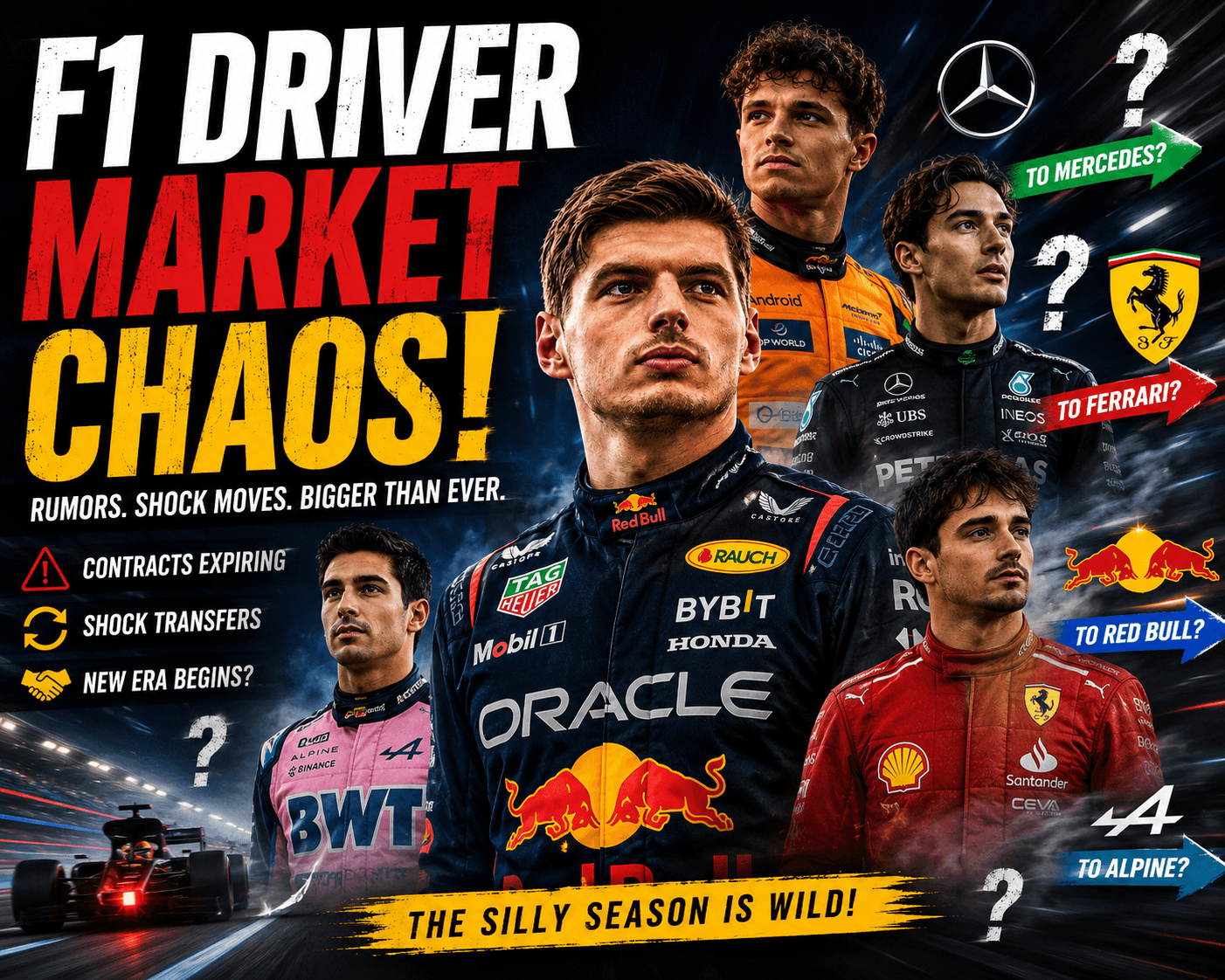
The F1 Driver Market Chaos has become one of the biggest stories of the 2026 Formula 1 season. Driver contracts, team ambitions and championship battles are creating a complicated puzzle for the 2027 grid.
For much of the year, one name dominated the conversation: Max Verstappen. Speculation about a possible move to Mercedes or McLaren created the possibility of a massive chain reaction. But that particular story has now changed dramatically. Verstappen has committed to Red Bull through the end of 2030, stabilizing one of the biggest pieces of the market.
That does not mean the drama is over.
Fernando Alonso's future at Aston Martin remains an important question, while drivers such as George Russell, Oscar Piastri, Carlos Sainz and Oliver Bearman remain important names in the wider market discussion.
With Formula 1 operating with only a limited number of race seats, one decision can trigger another surprisingly quickly. The driver market is therefore like a row of dominoes: move one important piece and several others may fall.
Table of Contents
| Sr# | Headings |
|---|---|
| 1 | F1 Driver Market Chaos Explained |
| 2 | Why the 2027 Driver Market Became So Complicated |
| 3 | Max Verstappen's Red Bull Decision |
| 4 | Mercedes and the George Russell Question |
| 5 | McLaren's Norris-Piastri Situation |
| 6 | Fernando Alonso and Aston Martin |
| 7 | Carlos Sainz's Future |
| 8 | Oliver Bearman and the Next Generation |
| 9 | Red Bull's Driver Puzzle |
| 10 | The Haas and Cadillac Battles |
| 11 | Which Drivers Could Still Move? |
| 12 | How One Contract Can Change the Grid |
| 13 | 2027 F1 Driver Market Predictions |
| 14 | Why the Driver Market Matters for Fantasy F1 |
| 15 | Final Verdict and FAQs |
1. F1 Driver Market Chaos Explained
The F1 Driver Market Chaos refers to the uncertainty surrounding driver contracts, team lineups and potential moves ahead of the 2027 Formula 1 season.
The term "silly season" is commonly used in F1 for the period when teams, drivers and journalists focus heavily on future contracts and transfers. Unlike many other sports, however, Formula 1 has a very small number of available seats.
That makes every opening valuable.
A driver leaving one team can create an opportunity for another driver. A top-team signing can force an existing driver to search for another seat. A veteran retirement can open a completely new path for a young prospect.
The 2026 market initially looked especially chaotic because many drivers had uncertain futures. But several major decisions have since reduced the number of possible moves.
Most importantly, Verstappen's decision to remain with Red Bull until 2030 removed the biggest potential domino from the board.
2. Why the 2027 Driver Market Became So Complicated
The 2027 market attracted so much attention because several major drivers had uncertain futures at different stages of 2026.
At the center was Verstappen.
Mercedes had been linked with the four-time world champion, while McLaren was also part of the speculation. His future mattered because signing Verstappen could have forced another elite driver out of a seat.
Fernando Alonso was another major variable.
At 45, the Aston Martin driver has to decide whether he wants to continue competing in Formula 1. His decision could affect Aston Martin's plans and create an opportunity for another driver.
Then there are drivers looking for opportunities further down the grid.
Carlos Sainz has faced frustration at Williams, while young drivers including Oliver Bearman and Red Bull prospect Arvid Lindblad are looking for opportunities to move upward.
This is why the market can become complicated so quickly.
One decision at the top can create several opportunities elsewhere.
3. Max Verstappen's Red Bull Decision
The biggest piece of the puzzle has now been placed.
Max Verstappen has committed to Red Bull through the end of 2030.
The decision ended months of speculation about a possible move to Mercedes or McLaren.
The decision is enormous for Red Bull.
Verstappen has been with the organization since his teenage years and has become the central figure of its modern success.
It also gives Red Bull long-term stability during a major technical era.
The 2026 regulations introduced significant changes to Formula 1 cars and power units, and Red Bull is now competing with its own power-unit program in partnership with Ford.
Why Verstappen Staying Matters
Before the announcement, there was a genuine possibility of a huge domino effect.
If Verstappen had moved to Mercedes, the team would have needed to decide which driver would leave.
That could have pushed another established driver onto the market.
The displaced driver could then have targeted Red Bull, McLaren, Ferrari, Aston Martin or another competitive team.
Now that Verstappen is staying, that particular chain reaction has largely disappeared.
4. Mercedes and the George Russell Question
Mercedes was one of the teams most closely connected to the Verstappen speculation.
George Russell's future became an especially interesting topic because a Verstappen move could potentially have created a direct seat battle.
The situation is now much clearer.
With Verstappen staying at Red Bull, Mercedes can focus on its existing competitive structure.
Russell remains an important part of the team's plans, while Kimi Antonelli has emerged as one of the biggest young stars in Formula 1.
That pairing could become one of the most important driver lineups of the next several seasons.
Kimi Antonelli's Rising Value
Antonelli has transformed the perception of Mercedes' future.
The Italian youngster has demonstrated that he can compete with established world champions.
That makes Mercedes less dependent on signing another superstar.
Instead, the team already has a potential championship-leading driver developing internally.
5. McLaren's Norris-Piastri Situation
McLaren's driver lineup is another major reason why the market is complicated.
Lando Norris and Oscar Piastri are both established at McLaren, creating one of the strongest driver pairings on the grid.
That means McLaren is not an obvious destination for another superstar.
And that was important during the Verstappen speculation.
If Verstappen had wanted McLaren, the team would have faced an extremely difficult choice between established drivers.
Norris vs Piastri
The Norris-Piastri partnership has already produced one of the most competitive internal battles in modern F1.
Both drivers have demonstrated championship-level potential.
McLaren therefore has little reason to break up the pairing.
The bigger question is whether either driver eventually becomes unhappy if one consistently receives stronger championship opportunities.
For now, however, the team has a premium lineup.
6. Fernando Alonso and Aston Martin
Fernando Alonso is arguably the biggest remaining uncertainty.
The two-time world champion is now 45, and the question of whether he wants to continue racing remains important for Aston Martin.
Alonso's situation is unusual.
Age alone does not necessarily determine his future.
His performance remains strong, and Aston Martin has the potential to become much more competitive as its technical program develops.
Adrian Newey has also spoken positively about Alonso's contribution to the team.
The Honda Factor
Aston Martin's relationship with Honda is another important piece.
The competitiveness of the power unit could influence Alonso's decision.
If Aston Martin looks capable of fighting regularly near the front, another season may become more attractive.
If the project continues to struggle, retirement could become easier to consider.
That makes Alonso's future one of the remaining major variables in the 2027 driver market.
7. Carlos Sainz's Future
Carlos Sainz is another driver worth watching.
After leaving Ferrari for Williams, Sainz entered a new phase of his career.
Williams has shown signs of progress, but the team's competitiveness has not yet consistently matched the expectations of a driver with Sainz's experience.
Sainz remains attractive to teams because he brings several qualities.
Race experience, technical feedback, consistency, strategic intelligence and strong qualifying ability all make him a valuable candidate.
If a top or midfield seat opens, Sainz could become one of the most logical experienced candidates.
8. Oliver Bearman and the Next Generation
The driver market is not only about established stars.
Young drivers are becoming increasingly important.
Oliver Bearman is one of the names attracting attention.
The Ferrari-affiliated driver has spent his first full F1 seasons with Haas and has shown enough potential to generate interest beyond the immediate midfield.
A stronger opportunity could eventually become available if an established driver leaves.
Arvid Lindblad
Red Bull's young prospect Arvid Lindblad is another driver to watch.
Lindblad has impressed during his early Formula 1 career and is considered one of the promising young drivers within the Red Bull system.
The challenge for Red Bull is timing.
Promoting a young driver can produce an exciting future.
But placing two inexperienced drivers together at a senior team can also create risk.
9. Red Bull's Driver Puzzle
Red Bull now has one major piece locked down: Verstappen.
The next question is what the team wants alongside him.
The ideal teammate must be fast enough to contribute points but also capable of operating within a highly competitive environment.
Red Bull has traditionally developed young drivers through its junior program.
Stay With Experience
The team could prioritize an experienced driver who can provide immediate results.
Promote a Young Driver
Red Bull could instead give a prospect a chance to learn alongside Verstappen.
Look Outside the Academy
The team could also sign an established driver from another organization.
Each strategy carries a different level of risk.
10. The Haas and Cadillac Battles
The lower half of the grid could provide some of the most interesting opportunities.
Haas has been linked with several potential candidates for future seats.
Young prospects and experienced drivers are competing for opportunities that could shape the next phase of their careers.
Cadillac is another important factor in the broader driver market.
The arrival of a new team creates additional opportunities, but those seats are still highly competitive.
For young drivers, a seat at a new team can be both an opportunity and a gamble.
A new organization may provide long-term upside, but immediate performance is not guaranteed.
11. Which Drivers Could Still Move?
Fernando Alonso
His decision could create one of the most attractive openings in the market.
Carlos Sainz
A competitive opportunity could become attractive if Williams cannot match his ambitions.
Oliver Bearman
The young Ferrari-linked driver could become a candidate for a stronger seat.
Red Bull Juniors
Arvid Lindblad and other academy drivers could enter the conversation if Red Bull decides to promote from within.
Midfield Candidates
The battle for available midfield seats could become intense as teams evaluate experience, performance and long-term potential.
This is where the 2027 market becomes less about blockbuster transfers and more about strategic career moves.
12. How One Contract Can Change the Grid
This is the most fascinating part of the F1 driver market.
Imagine a top team signs a driver.
That team's existing driver needs another seat.
Another team sees an opportunity.
Its current driver then becomes available.
A junior driver receives a promotion.
Suddenly, one contract has influenced several teams.
That is why F1's driver market behaves like dominoes.
The Verstappen situation demonstrated this perfectly.
If he had left Red Bull, Mercedes or McLaren could have changed their lineup, which could then have affected Red Bull and potentially several midfield teams.
Now that Verstappen has committed to Red Bull, the domino chain is much smaller.
13. 2027 F1 Driver Market Predictions
Prediction 1: Verstappen Stays at Red Bull
This is confirmed through 2030.
Prediction 2: Mercedes Keeps Its Core Lineup
The team's performance makes Russell and Antonelli an increasingly valuable combination.
Prediction 3: McLaren Retains Norris and Piastri
McLaren has little reason to break up one of the strongest driver pairings on the grid.
Prediction 4: Alonso Becomes the Major Wild Card
His Aston Martin decision could influence several other drivers.
Prediction 5: Midfield Seats Create the Biggest Drama
Haas, Cadillac and other teams could provide opportunities for younger drivers and experienced competitors.
The market therefore appears to be moving from superstar chaos toward midfield reshuffling.
14. Why the Driver Market Matters for Fantasy F1
The driver market is not only interesting for Formula 1 fans.
It can also matter for fantasy sports players.
A driver moving to a stronger team can dramatically change his fantasy value.
Consider the difference between a driver regularly qualifying outside the top 10 and the same driver suddenly driving a championship-contending car.
The equipment changes the statistical ceiling.
Fantasy Factors to Watch
Qualifying performance can influence starting-position value.
Race finishes determine consistency.
Team reliability affects the number of races a driver can complete.
Teammate comparison can reveal whether a driver is outperforming expectations.
Constructor performance can influence the overall fantasy value of a driver pairing.
For SportsLNV readers, tracking the driver market can therefore provide useful context before selecting fantasy F1 rosters.
15. Final Verdict
The F1 Driver Market Chaos has changed dramatically during 2026.
The biggest uncertainty has already been resolved.
Verstappen is staying at Red Bull through 2030.
That decision removes the biggest uncertainty from the 2027 grid.
Now attention turns toward Fernando Alonso, midfield opportunities, young-driver promotions and the teams still deciding how aggressively they want to reshape their lineups.
For fans, the next stage of the silly season may be less about one blockbuster transfer and more about a series of smaller decisions.
And in Formula 1, those smaller decisions can still create enormous consequences.
Frequently Asked Questions About F1 Driver Market Chaos
1. What is the F1 driver market?
The F1 driver market is the process through which teams and drivers negotiate contracts, renew existing agreements and arrange moves between teams for future seasons.
2. Is Max Verstappen leaving Red Bull?
No. Verstappen has committed to Red Bull through the end of the 2030 Formula 1 season.
3. Why was Verstappen's future so important to the 2027 F1 driver market?
Verstappen was one of the most valuable possible moves because a transfer to Mercedes or McLaren could have forced another elite driver out of a seat and triggered several additional transfers.
4. Will Fernando Alonso continue in Formula 1?
Alonso's future remains an important question. His age, Aston Martin's competitiveness and the team's long-term project could all influence his decision.
5. Which young drivers could benefit from the F1 driver market?
Drivers such as Oliver Bearman and Arvid Lindblad are among the young talents who could benefit if competitive seats become available.
6. Could Carlos Sainz change teams again?
Sainz remains an experienced and attractive option for teams seeking a proven driver. His future will depend on available seats and Williams' competitive trajectory.
7. Why is the F1 driver market called silly season?
The term refers to the period when rumors, negotiations and speculation about future driver moves become particularly intense, often producing surprising stories.
8. How many drivers compete in a full F1 grid?
The current Formula 1 grid contains 22 race seats, making every available position extremely valuable.
9. Will McLaren change its driver lineup for 2027?
McLaren currently has Lando Norris and Oscar Piastri as its established driver pairing, making continuity the most logical expectation unless circumstances change.
10. Why does the F1 driver market matter for fantasy sports?
Driver moves can change expected qualifying positions, race results and consistency. A move to a faster car can significantly increase a driver's potential fantasy value.
Conclusion
The F1 Driver Market Chaos is entering a new phase.
Verstappen's decision to remain at Red Bull through 2030 has removed the biggest uncertainty from the 2027 grid.
Now attention turns toward Fernando Alonso, midfield opportunities, young-driver promotions and the teams still deciding how they want to shape their future lineups.
For fans, the next stage of the silly season may be less about one blockbuster transfer and more about a series of smaller decisions.
In Formula 1, however, those smaller decisions can still create enormous consequences.
Raan, a Harvard alumnus, details analytics and fantasy sports for SportsLNV.
Related Blogs:◉ Cristiano Ronaldo: Career, Records & Football Legacy
◉ Top 10 FIFA Player Ratings 2025
◉ Switzerland vs Colombia — World Cup 2026 Round of 16 Preview
◉ Neymar: Biography, Career, Skills & Legacy
◉ Jaylen Reed: Biography, Career, Stats, Team, Age & Latest News
◉ World best football player in the world
◉ Harry Kane: Career, Stats, Records & Journey to Football Greatness
◉ Erling Haaland: Biography, Career & Records
◉ Mohamed Salah Biography: Career, Stats, Achievements & Legacy
◉ Football: Complete Guide to Rules, Positions, History, Tactics & More
◉ Sports LNV
Comments (0)
You must be logged in to comment.
Sign InTeams
20Explore team pages & exclusive profiles
📖 You Might Also Like
UFC Fight Night Predictions 2026: Picks & Analysis
Read the latest in-depth analysis from our sports experts.

US Open Wildcard Entries 2026: Players to Watch
Read the latest in-depth analysis from our sports experts.
US Open Injury Report 2026: Latest Player Updates
Read the latest in-depth analysis from our sports experts.