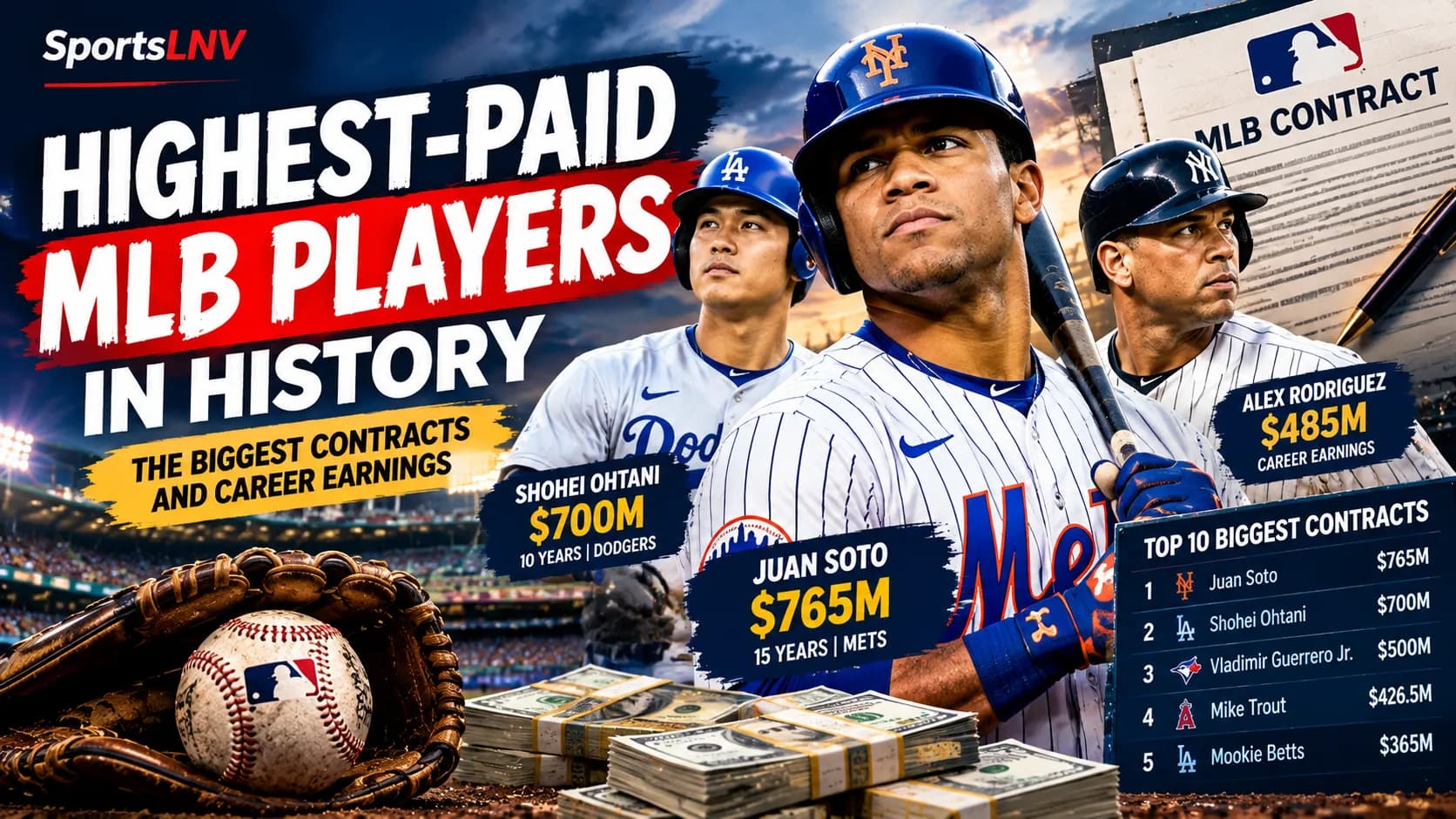
The highest-paid MLB player in history by total contract value is Juan Soto, who signed a 15-year, $765 million deal with the New York Mets after the 2024 season. The agreement established a new benchmark for Major League Baseball contracts.
However, the player with the highest total contract value is not necessarily the player who has earned the most money during an entire career. Alex Rodriguez has earned approximately $485 million in reported on-field career earnings, according to certain salary databases. These two rankings tell different stories about how baseball salaries have grown over time.
This guide examines the biggest MLB contracts, the players with the highest annual contract values, career earnings leaders, and the financial changes that have transformed professional baseball.
The 10 Biggest Contracts in MLB History
The following table ranks major MLB contracts by total guaranteed value, including free-agent deals and contract extensions. Contract structures, deferred payments, signing bonuses, and opt-out provisions can affect how these agreements compare financially.
| Rank | Player | Team | Contract Length | Total Value | Signed |
|---|---|---|---|---|---|
| 1 | Juan Soto | New York Mets | 15 years | $765 million | 2024 |
| 2 | Shohei Ohtani | Los Angeles Dodgers | 10 years | $700 million | 2023 |
| 3 | Vladimir Guerrero Jr. | Toronto Blue Jays | 14 years | $500 million | 2025 |
| 4 | Mike Trout | Los Angeles Angels | 12 years | $426.5 million | 2019 |
| 5 | Mookie Betts | Los Angeles Dodgers | 12 years | $365 million | 2020 |
| 6 | Aaron Judge | New York Yankees | 9 years | $360 million | 2022 |
| 7 | Manny Machado | San Diego Padres | 11 years | $350 million | 2023 |
| 8 | Francisco Lindor | New York Mets | 10 years | $341 million | 2021 |
| 9 | Fernando Tatis Jr. | San Diego Padres | 14 years | $340 million | 2021 |
| 10 | Bryce Harper | Philadelphia Phillies | 13 years | $330 million | 2019 |
Sources for contract comparisons include BetMGM's MLB contract rankings and MLB.com's largest contract breakdown. Other major agreements include contracts worth approximately $324 million to $325 million for players such as Giancarlo Stanton, Corey Seager, Yoshinobu Yamamoto, and Gerrit Cole.
Juan Soto: The $765 Million Contract
Juan Soto entered free agency at just 26 years old, giving teams the opportunity to sign an elite hitter for a substantial portion of his prime playing years.
The New York Mets won the bidding competition with a 15-year, $765 million agreement following the 2024 season. The deal runs through 2039 and carries an average annual value of $51 million before considering the effects of any contract adjustments.
One important feature is that Soto's contract does not rely on the massive deferred salary structure used in Shohei Ohtani's agreement. That difference matters when comparing the headline values and the timing of player payments.
The Soto contract demonstrates how a combination of age, offensive production, market demand, and long-term team planning can create record-setting agreements in MLB.
Shohei Ohtani: The $700 Million Contract and Deferred Money
Shohei Ohtani's 10-year, $700 million contract with the Los Angeles Dodgers attracted enormous attention when it was agreed in December 2023.
The agreement includes $680 million in deferred compensation, allowing Ohtani to receive only $2 million annually during the 10-year playing term, with the deferred payments scheduled for later years.
This unusual structure affects how the deal should be compared with other contracts. The headline value is $700 million, but the present value of that money is lower because most of it is paid in the future.
Soto's agreement is larger by nominal total value, while Ohtani's arrangement shows how deferrals can give a team greater flexibility in managing its near-term payroll.
The Dodgers secured a rare two-way superstar who contributes as both a hitter and a pitcher. His signing also illustrates how contract design can influence a team's ability to build a competitive roster around an expensive player.
For more about the Dodgers and their place in MLB, read our Dodgers vs Rockies: Complete Guide, History, Players & More.
Vladimir Guerrero Jr.: The $500 Million Extension
Vladimir Guerrero Jr. signed a 14-year, $500 million extension with the Toronto Blue Jays in April 2025. The agreement became one of the biggest contracts in MLB history and the largest contract in the Blue Jays' franchise history.
Unlike players who sign a major deal after entering free agency, Guerrero agreed to remain with Toronto before reaching the open market. His extension represents the value the organization placed on retaining a franchise cornerstone for the long term.
The deal also highlights how contract negotiations can benefit both sides. The team secures a major player for many years, while the player gains long-term financial security without testing free agency.
Large extensions involve risk, however. A team must consider a player's future health, age, performance, and the financial flexibility it may need to build a competitive roster around the contract.
The Highest Yearly Salaries in MLB
Total contract value rewards players who secure long agreements. Average annual value (AAV) provides a different perspective by showing the nominal average value of a contract per year.
Some of the major annual-value agreements in the supplied rankings include:
- Shohei Ohtani: $70 million per year in headline average annual value.
- Kyle Tucker: $60 million per year on his four-year, $240 million Dodgers agreement.
- Juan Soto: $51 million per year on his 15-year, $765 million agreement.
According to MLB.com's report on Kyle Tucker's Dodgers contract, the four-year agreement includes a $64 million signing bonus, $30 million in deferred compensation, and opt-outs after the second and third seasons.
Tucker's contract illustrates an alternative strategy for elite players. Instead of committing to a much longer deal, a player may choose a shorter contract with a high annual value and options to return to free agency sooner.
AAV is useful for comparing contracts, but it does not automatically show the exact cash a player receives each season. Bonuses, deferrals, opt-outs, and other provisions must also be considered.
The Biggest Career Earners in MLB History
Total contract value shows the size of an agreement, while career earnings estimate the money a player has earned across multiple contracts and playing seasons.
The following figures are approximate estimates from the career-earnings figures supplied for this article. Rankings can differ between databases depending on their accounting methods and the dates on which the numbers are updated.
| Rank | Player | Approximate Career Earnings |
|---|---|---|
| 1 | Alex Rodriguez | $485 million |
| 2 | Justin Verlander | $422 million |
| 3 | Miguel Cabrera | $393 million |
| 4 | Max Scherzer | $360 million |
| 5 | Albert Pujols | $341 million |
For current figures and methodology, consult a dedicated salary database such as Baseball-Reference's salary and career earnings tables. The amounts above should not be treated as audited totals or as measures of a player's net worth.
Alex Rodriguez signed two landmark contracts during his career: a 10-year, $252 million agreement with Texas before the 2001 season and a later 10-year, $275 million agreement with the New York Yankees.
Justin Verlander is another notable high earner, with a career that includes long-term contracts and agreements with multiple teams. Miguel Cabrera, Max Scherzer, and Albert Pujols also accumulated substantial earnings through extended careers and high-value contracts.
Career earnings are a cumulative measure. A player may earn more over time through a series of contracts than another player who holds a larger single agreement. The result depends on contract size, career length, guaranteed payments, bonuses, and how a database accounts for deferred compensation.
How MLB Contracts Became So Large
The growth of baseball salaries over several generations has been remarkable. Babe Ruth reportedly earned $80,000 in 1930, while Nolan Ryan's 1979 agreement with Houston helped establish a new benchmark for annual salary.
Modern contracts have grown as television rights, sponsorships, stadium revenue, league economics, and free agency have reshaped the business of baseball. Teams now operate in a financial environment very different from the one that existed during Ruth's career.
The comparison between older salaries and today's contracts shows the scale of that change. However, comparing salaries across eras also requires accounting for inflation, differences in league revenue, and changes in how players negotiate compensation.
Large contracts are ultimately financial bets on future performance. A star player can improve a team's competitiveness, attract fans, support merchandise sales, and help create long-term franchise value. But a lengthy contract can also become a burden if a player's performance declines, injuries reduce playing time, or the team's priorities change.
The Dodgers' investment in Shohei Ohtani demonstrates the ambition behind a major signing, while long-term deals across the league show how much risk organizations are willing to accept to retain elite talent.
For another look at notable MLB achievements and the records players set on the field, read our guide to the most home runs in an MLB game.
Frequently Asked Questions About MLB Contracts
Who has the biggest contract in MLB history?
Juan Soto signed a 15-year, $765 million contract with the New York Mets after the 2024 season. It is the largest MLB contract by total nominal value in the ranking covered in this article.
Who has earned the most money during an MLB career?
Alex Rodriguez is listed among the leading MLB career earners, with reported on-field earnings of approximately $485 million in some databases. Exact totals can differ depending on the source and accounting method.
How does Shohei Ohtani's contract compare with Juan Soto's?
Ohtani's contract is worth $700 million over 10 years, while Soto's is worth $765 million over 15 years. Ohtani's agreement includes substantial deferred compensation, which affects the present value and timing of his payments.
What does average annual value mean in MLB?
Average annual value, or AAV, is the nominal total value of a contract divided by its length. It is commonly used to compare the average annual size of contracts, although it does not necessarily equal the player's cash salary in every season.
Why do teams offer contracts worth hundreds of millions of dollars?
Teams compete to sign elite players who can improve performance, increase fan interest, strengthen the roster, and support the franchise's long-term goals. The financial value of a player must be weighed against the risk of injuries, declining performance, and reduced payroll flexibility.
Related MLB Stories
- Most Home Runs in an MLB Game: The Records and 10 Four-Homer Games to Remember — explore historic home-run achievements and individual MLB records.
- Ketel Marte: Biography, Career, Stats, Position & More — read about the Arizona Diamondbacks player's career and statistics.
- Dodgers vs Rockies: Complete Guide, History, Players & More — learn about the teams, players, and history behind this MLB matchup.
- The Longest Baseball Game in MLB History — discover remarkable MLB marathon games and records.
Sources
Comments (0)
You must be logged in to comment.
Sign InTeams
29Explore team pages & exclusive profiles
📖 You Might Also Like

Shortest Players in MLB History: From Gaedel to Altuve
Read the latest in-depth analysis from our sports experts.

Most Home Runs in an MLB Game: The Records and 10 Four-Homer Games to Remember
Read the latest in-depth analysis from our sports experts.

The Longest Baseball Game in MLB History
Read the latest in-depth analysis from our sports experts.